Introduction
Organic Chemistry is an important chapter in the ICSE Class 10 Chemistry syllabus. To help students understand the concepts and prepare effectively for their board examinations, we have provided ICSE Class 10 Chemistry Chapter 12 Organic Chemistry Selina Solutions with clear, accurate and easy-to-understand answers.
These Selina Concise Chemistry Class 10 solutions cover textbook exercises, important questions and answers, chemical reactions and essential concepts related to Organic Chemistry. Students can use these solutions to complete their homework, revise important topics and strengthen their understanding of the chapter.
Study Support by Rohit Academy
Rohit Academy offers expert-curated ICSE Class 10 Chemistry Study Materials, including ICSE Organic Chemistry Selina Solutions, diagrams, and key formulas for better understanding.
Study materials related to Chapter 12: Organic Chemistry
To help you prepare thoroughly for the entire chapter, explore the following study resources for Chapter 12: Organic Chemistry.
| ☛ ICSE Class 10 Chemistry Chapter 12: Organic Chemistry Note |
| ☛ ICSE Class 10 Chemistry Chapter 12: Organic Chemistry Previous Year Questions |
Intext Questions 1 [Page No: 198]
Question 1
(a) What are organic compounds?
(b) What is vital force theory? Why was it discarded?
Answer:
(a) Organic compounds are compounds of carbon, usually containing hydrogen and often other elements such as oxygen, nitrogen, sulphur and halogens.
Examples: methane (CH4), ethane (C2H6) and ethanol (C2H5OH).
(b) The vital force theory stated that organic compounds could be produced only by living organisms due to the presence of a
special vital force.
It was discarded in 1828 when Friedrich Wöhler prepared urea, an organic compound, from ammonium cyanate, an inorganic compound, in the laboratory.
Question 2
(a) Name a few sources of organic compounds.
(b) Give the various applications of organic chemistry.
Answer:
(a) The main sources of organic compounds are:
- Plants
- Animals
- Coal
- Petroleum
- Natural gas
- Laboratory synthesis
(b) Organic chemistry has applications in the following fields:
- Medicine: Preparation of drugs and antibiotics.
- Agriculture: Manufacture of pesticides, insecticides and herbicides.
- Food industry: Production of preservatives, flavours and food additives.
- Textile industry: Manufacture of synthetic fibres such as nylon and polyester.
- Plastic industry: Production of plastics, rubber and polymers.
- Cosmetics: Manufacture of perfumes, soaps and creams.
- Fuel industry: Production of petrol, diesel, LPG and other fuels.
Question 3
Organic chemistry plays a key role in all walks of life. Discuss.
Answer:
Organic chemistry plays an important role in our daily lives. Food contains organic compounds such as carbohydrates, proteins and fats. Medicines are used to prevent and cure diseases. Fuels such as petrol, diesel and natural gas provide energy. Plastics, synthetic fibres, soaps, detergents, cosmetics and paints are also made from organic compounds. Thus, organic chemistry is essential in medicine, agriculture, industry, transportation and everyday life.
Question 4
Carbon shows some unique properties, name them.
Answer:
The two unique properties of carbon are:
- Tetravalency: Carbon has a valency of four.
- Catenation: Carbon atoms can bond with one another to form long chains, branched chains and rings.
Question 5
Explain the following:
(a) Tetravalency
(b) Catenation
Answer:
(a) Tetravalency: Carbon has four electrons in its outermost shell. It shares these electrons with other atoms to form four covalent bonds. This property of carbon is called tetravalency.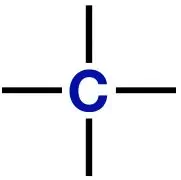
(b) Catenation: The property of carbon atoms to combine with other carbon atoms through covalent bonds to form long chains, branched chains or rings is called catenation.
Example: Butane (CH3–CH2–CH2–CH3).
Question 6
Write any four properties of organic compounds that distinguish them from inorganic compounds.
Answer:
| Organic compounds | Inorganic compounds |
| Generally have low melting and boiling points. | Generally have high melting and boiling points. |
| Generally are insoluble in water but soluble in organic solvents. | Many are soluble in water. |
| Generally are poor conductors of electricity. | Many conduct electricity in molten or aqueous states. |
| Many are combustible. | Many are non-combustible. |
Question 7
Why are organic compounds studied as a separate branch of chemistry?
Answer:
Organic compounds are studied as a separate branch of chemistry because carbon forms an exceptionally large number of compounds due to its tetravalency and catenation. These compounds have diverse structures, properties and reactions. Therefore, their study requires specialised concepts and methods.
Question 8
What are hydrocarbons? Compare saturated and unsaturated hydrocarbons?
Answer:
Hydrocarbons are organic compounds containing only carbon and hydrogen atoms.
| Saturated hydrocarbons | Unsaturated hydrocarbons |
| Contain only single bonds between carbon atoms. | Contain at least one double or triple bond between carbon atoms. |
| Examples: Alkanes. | Examples: Alkenes and alkynes. |
| Example: Ethane (C2H6). | Examples: Ethene (C2H4) and ethyne (C2H2). |
| Generally undergo substitution reactions. | Generally undergo addition reactions. |
Question 9
Give reason for the existence of the large number of organic compounds.
Answer:
The large number of organic compounds exists mainly due to the following properties of carbon:
- Tetravalency: Carbon forms four covalent bonds.
- Catenation: Carbon atoms form long chains, branched chains and rings.
- Multiple bonding: Carbon forms single, double and triple bonds.
- Isomerism: Compounds can have the same molecular formula but different structures.
- Combination with other elements: Carbon combines with hydrogen, oxygen, nitrogen, sulphur and halogens to form numerous compounds.
Question 10
Give at least one example in each case to show the structure of:
(a) Single bond compound
(b) Double bond compound
(c) Triple bond compound
Answer:
(a) Single bond compound:
Example: Ethane (C2H6)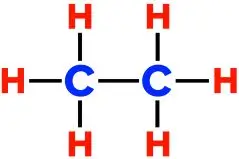
(b) Double bond compound:
Example: Ethene (C2H4)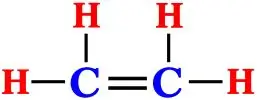
(c) Triple bond compound:
Example: Ethyne (C2H2)
Question 11
Name a compound of each type and draw the figure,
(a) Cyclic compound with single bond
(b) Cyclic compound with triple bond
Answer:
(a) Cyclopropane [C3H6]: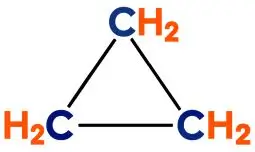
(b) Cyclopentyne [C5H6]: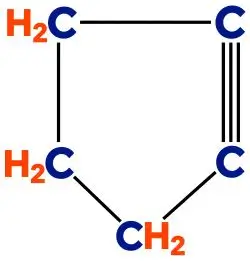
Question 12
Give the name of one member of each of the following:
(a) saturated hydrocarbons
(b) unsaturated hydrocarbons
Answer:
(a) Methane (CH4)
(b) Ethene (C2H4)
Question 13
Define substitution and addition reactions. Give an example for each.
Answer:
(a) Substitution reaction:
A chemical reaction in which one atom or group of atoms in a compound is replaced by another atom or group is called a substitution reaction.
Example: Chlorination of methane in the presence of sunlight.
(b) Addition reaction:
A chemical reaction in which atoms or groups of atoms add to an unsaturated compound to form a single product is called an addition reaction.
Example: Addition of hydrogen to ethene in the presence of a nickel catalyst.
Intext Questions 2 [Page No: 201]
Question 1
Define a functional group and give the structural formula of the following functional groups:
(a) Ketone
(b) Alcohols
(c) Aldehydes
Answer:
A functional group is an atom or group of atoms present in an organic compound that determines its characteristic chemical properties and reactions.
(a) 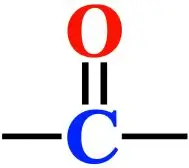
(b) –OH
(c) –CHO
Question 2
(a) What is a homologous series?
(b) What is the difference in the molecular formula of any two adjacent homologues:
1. in terms of molecular mass.
2. in terms of number and kind of atoms per molecule?
Answer:
(a) A homologous series is a group of organic compounds having a similar structure and similar chemical properties in which the successive compounds differ by a –CH2– group.
(b) The difference in the molecular formula of two adjacent homologues:
1. In terms of molecular mass: They differ by 14 u (14 g mol–1 in molar mass).
2. In terms of the number and kind of atoms per molecule: They differ by one carbon atom and two hydrogen atoms (–CH2– group).
Question 3
Write the name and formula of fourth member of the following homologous series:
(a) Alkyne
(b) Alcohol
Answer:
(a) Pentyne (C5H8)
(b) Butanol (C4H9OH)
Question 4
Which part of an organic compound determines
(i) Physical properties
(ii) Chemical properties
Answer:
(i) Alkyl group
(ii) Functional group
Question 5
(a) What is an alkyl group?
(b) Give the names of any three alkyl radicals. How are they formed?
Answer:
(a) An alkyl group of atoms is obtained by removing one atom of hydrogen from an alkane molecule.
Its general formula is CnH2n+1.
(b) Three examples of alkyl radicals are:
| Alkyl group | Formula | Formed from |
| Methyl | CH3– | Methane (CH4) |
| Ethyl | C2H5– | Ethane (C2H6) |
| Propyl | C3H7– | Propane (C3H8) |
They are formed by removing one hydrogen atom from the corresponding alkane molecule.
Question 6
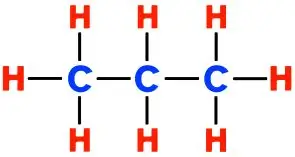
Give the names and the structural formula of the first three members of the homologous series of alkanes.
Answer:
First three members of the homologous series of alkanes are :
- Methane (CH4)

- Ethane (C2H6)
- Propane (C3H8)
Question 7
Name the alkyl radical and the functional group of the following organic compounds:
(a) CH3OH
(b) C2H5OH
(c) C3H7CHO
(d) C4H9COOH
(e) CH3COOH
(f) C2H5Br
Answer:
| Compound | Alkyl radical | Functional group |
| (a) CH3OH | Methyl (CH3–) | Alcohol (–OH) |
| (b) C2H5OH | Ethyl (C2H5–) | Alcohol (–OH) |
| (c) C3H7CHO | Propyl (C3H7–) | Aldehyde (–CHO) |
| (d) C4H9COOH | Butyl (C4H9–) | Carboxyl (–COOH) |
| (e) CH3COOH | Methyl (CH3–) | Carboxyl (–COOH) |
| (f) C2H5Br | Ethyl (C2H5–) | Bromo (–Br) |
Exercise 12 (A) [Page No: 208]
Question 1(a)
Write the IUPAC name of: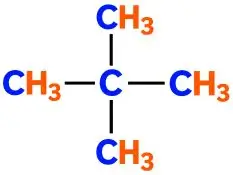
Answer:
2,2–Dimethylpropane
Question 1(b)
Write the IUPAC name of: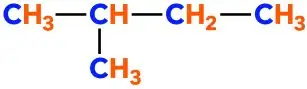
Answer:
2-Methylbutane
Question 1(c)
Write the IUPAC name of: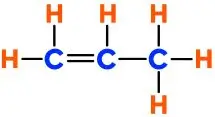
Answer:
Prop–1–ene
Question 1(d)
Write the IUPAC name of: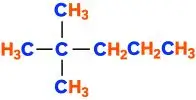
Answer:
2,2–Dimethylpentane
Question 1(e)
Write the IUPAC name of:
Answer:
Pent–2–yne
Question 1(f)
Write the IUPAC name of: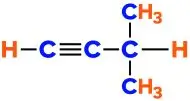
Answer:
3–Methylbut–1–yne
Question 1(g)
Write the IUPAC name of: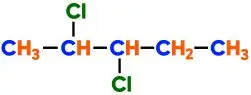
Answer:
2,3–Dichloropentane
Question 1(h)
Write the IUPAC name of: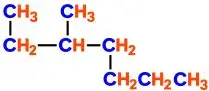
Answer:
3–Methylheptane
Question 1(i)
Write the IUPAC name of: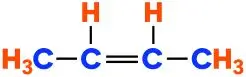
Answer:
But–2–ene
Question 1(j)
Write the IUPAC name of:
Answer:
Hept–2–yne
Question 1(k)
Write the IUPAC name of: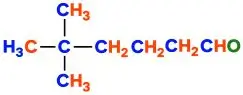
Answer:
5,5–Dimethylhexanal
Question 1(l)
Write the IUPAC name of: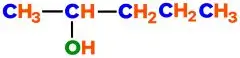
Answer:
Pentan–2–ol
Question 1(m)
Write the IUPAC name of: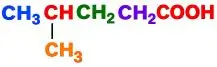
Answer:
4–Methylpentanoic acid
Question 1(n)
Write the IUPAC name of: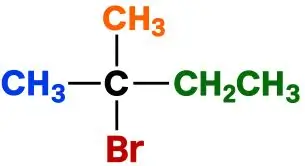
Answer:
2–Bromo–2–methylbutane
Question 1(o)
Write the IUPAC name of: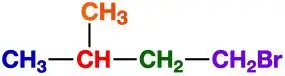
Answer:
1–Bromo–3–methylbutane
Question 1(p)
Write the IUPAC name of: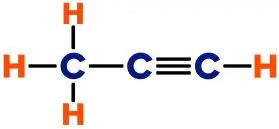
Answer:
Prop–1–yne
Question 1(q)
Write the IUPAC name of: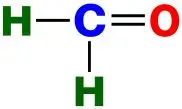
Answer:
Methanal
Question 1(r)
Write the IUPAC name of: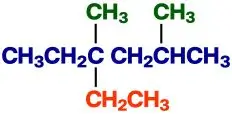
Answer:
3–ethyl–3,5–dimethylhexane
Question 1(s)
Write the IUPAC name of: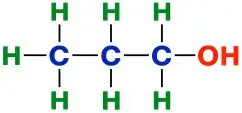
Answer:
Propan–1–ol
Question 1(t)
Write the IUPAC name of: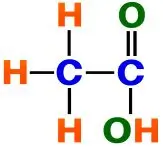
Answer:
Ethanoic acid
Question 1(u)
Write the IUPAC name of: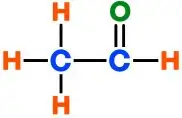
Answer:
Ethanal
Question 1(v)
Write the IUPAC name of: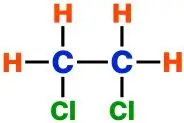
Answer:
1,2–Dichloroethane
Question 1(w)
Write the IUPAC name of: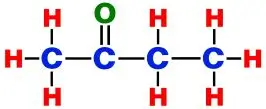
Answer:
But–2–one
Question 1(x)
Write the IUPAC name of: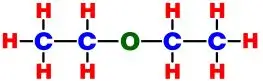
Answer:
Ethoxyethane
Question 1(y)
Write the IUPAC name of: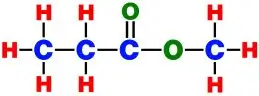
Answer:
Methyl propanoate
Question 1(z)
Write the IUPAC name of: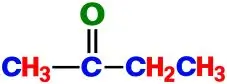
Answer:
But–2–one
Question 2
Draw the structures of the following compounds:
(a) Prop–1–ene
(b) 2,3–Dimethylbutane
(c) 2–Methylpropane
(d) 3–Hexene
(e) Prop–1–yne
(f) 2–Methylprop–1–ene
(g) Alcohol with molecular formula C4H10O
Answer:
(a) Prop–1–ene: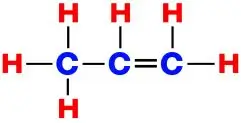
(b) 2,3–Dimethylbutane: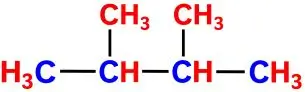
(c) 2–Methylpropane: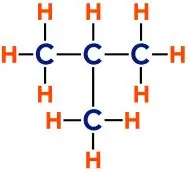
(d) 3–Hexene: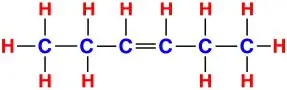
(e) Prop–1–yne: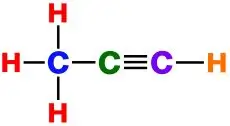
(f) 2–Methylprop–1–ene: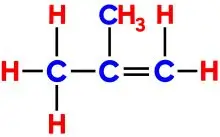
(g) Alcohol with molecular formula C4H10O: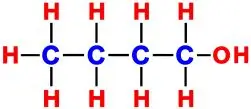
Question 3(a)
Choose the correct answer:
C5H11 is an:
(i) Alkane (ii) Alkene
(iii) Alkyne (iv) Alkyl group
Answer:
(iv) Alkyl group
Explanation: Alkanes have the general formula CnH2n+2. When one hydrogen atom is removed from an alkane, an alkyl group is formed.
Question 3(b)
Choose the correct answer:
A hydrocarbon of the general formula CnH2n is:
(i) C15H30 (ii) C12H26
(iii) C8H20 (iv) C6H14
Answer:
(i) C15H30
Explanation:
According to the formula CnH2n, the number of hydrogen atoms is twice the number of carbon atoms. Therefore, C15H30 follows the general formula CnH2n, where n = 15.
Question 3(c)
Choose the correct answer:
The total number of different carbon chains that four carbon atoms form in an alkane is:
(i) 5 (ii) 4
(iii) 3 (iv) 2
Answer:
(iv) 2
Explanation:
Four carbon atoms form two different carbon-chain arrangements in alkanes:
- Straight chain — Butane
CH3–CH2–CH2–CH3 - Branched chain — 2-Methylpropane
CH3–CH(CH3)–CH3
Both compounds have the molecular formula C4H10 but different carbon-chain arrangements. Therefore, there are two different carbon chains.
Question 3(d)
Choose the correct answer:
CH3–CH2–OH and CH3–O–CH3 are:
(i) Position isomers (ii) Chain isomers
(iii) Homologues (iv) Functional isomers
Answer:
(iv) Functional isomers
Explanation:
Both compounds have the same molecular formula, C2H6O, but different functional groups.
- CH3–CH2–OH: Ethanol, an alcohol containing the –OH functional group.
- CH3–O–CH3: Methoxymethane (dimethyl ether), an ether containing the –O– linkage.
Compounds having the same molecular formula but different functional groups are called functional isomers.
Question 3(e)
Choose the correct answer:
The IUPAC name of the compound is: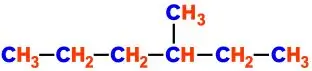
(i) 3-Trimethylhexane (ii) 3-Methylhexane
(iii) 4-Methylhexane
Answer:
(ii) 3-Methylhexane
Explanation:
The longest carbon chain contains six carbon atoms, so the parent name is hexane. A methyl group (–CH3) is attached to the third carbon atom. Hence, the IUPAC name is 3-methylhexane.
Question 4
Fill in the blanks:
(a) Propane and ethane are …………… (homologous, isomers)
(b) A saturated hydrocarbon does not participate in a/an …………… reaction (substitution, addition)
(c) Succeeding members of a homologous series differ by …………… (CH, CH2, CH3)
(d) As the molecular masses of hydrocarbons increase, their boiling points …………… and melting points …………… (increase, decrease)
(e) C25H52 and C50H102 belong to …………… homologous series (the same, different)
(f) CO is an …………… compound. (organic, inorganic)
(g) The chemical properties of an organic compound are largely decided by the …………… and the physical properties of an organic
compound are largely decided by the …………… (functional group, number of carbon atoms)
(h) CHO is the functional group of an …………… (alcohol, aldehyde)
(i) The root in the IUPAC name of an organic compound depends upon the number of carbon atoms in …………… (any chain,
principal chain)
(j) But–1–ene and but–2–ene are examples of …………… isomerism (chain, position, functional)
Answer:
(a) Propane and ethane are homologous.
(b) A saturated hydrocarbon does not participate in a/an addition reaction.
(c) Succeeding members of homologous series differ by CH2.
(d) As the molecular masses of hydrocarbons increase, their boiling points increase and melting points increase.
(e) C25H52 and C50H102 belong to the same homologous series
(f) CO is an inorganic compound.
(g) The chemical properties of an organic compound are largely decided by the functional group and the physical properties of an
organic compound are largely decided by the number of carbon atom.
(h) CHO is the functional group of an aldehyde.
(i) The root in the IUPAC name of an organic compound depends upon the number of carbon atoms in principal chain.
(j) But-1-ene and but-2-ene are examples of position isomerism.
Question 5
Define or explain chain isomerism and position isomerism with examples in each case.
Answer:
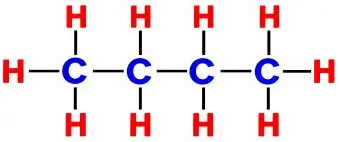
(a) Chain Isomerism: The phenomenon in which two or more organic compounds have the same molecular formula but different arrangements of the carbon chain is called chain isomerism.
Example: Butane and 2–methylpropane (C4H10).
- Butane
- 2–methylpropane
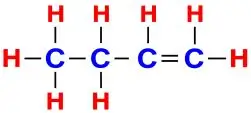
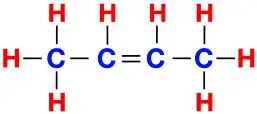
(b) Position Isomerism: The phenomenon in which two or more organic compounds have the same molecular formula and carbon skeleton but differ in the position of a functional group or multiple bond is called position isomerism.
Example: But–1–ene and but–2–ene (C4H8).
- But–1–ene
- But–2–ene
Question 6(a)
Define the term isomerism. State two main causes of isomerism.
Answer:
Isomerism is the phenomenon in which two or more organic compounds have the same molecular formula but different structural formulae.
The two main causes of isomerism are:
- Different arrangements of the carbon chain: Carbon atoms can form straight or branched chains.
- Different arrangements of atoms or groups: Functional groups or multiple bonds may occupy different positions in the carbon chain.
Question 6(b)
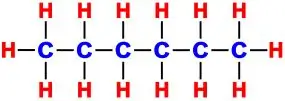
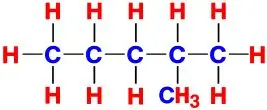
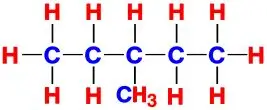
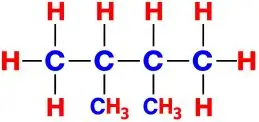
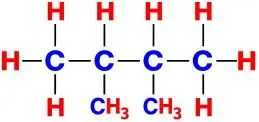
Draw the chain isomers of hexane (C6H14).
Answer:
Hexane (C6H14) has five chain isomers.
- Hexane
- 2–Methylpentane
- 3–Methylpentane
- 2,2–Dimethylbutane
- 2,3–Dimethylbutane
Question 6(c)
Draw position isomers of butene (C4H8)
Answer:
Butene has two position isomers:
- But–1–ene
- But–2–ene
Question 7
Draw structural formula for each of the following compounds:
(a) isomer of n–butane
(b) Vinegar
(c) 2–Propanol
(d) Ethanal
(e) Acetone
(f) Diethyl ether
(g) propanoic acid
(h) pentan–2–ol
(i) 2,2–dibromobutane
What is used to describe these compounds together?
Answer:
(a) Isomer of n-butane is Isobutane: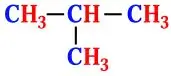
(b) Vinegar: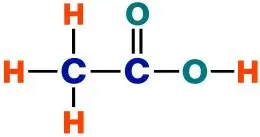
(c) 2–Propanol: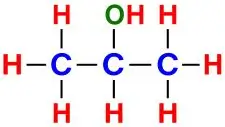
(d) Ethanal:
(e) Acetone: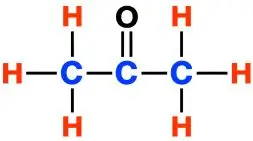
(f) Diethyl ether: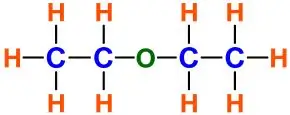
(g) propanoic acid: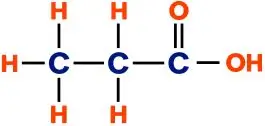
(h) pentan–2–ol: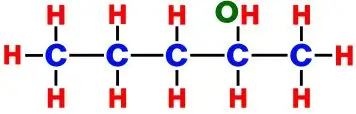
(i) 2,2–dibromobutane: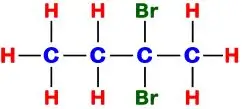
These compounds together can be called organic compounds.
Question 8
(a) What is the special feature of the structure of:
(i) Ethene
(ii) Ethyne
(b) What type of reaction is common to both of the above compounds? Why methane does not undergo this type of reaction.
(c) What is the IUPAC name of dimethyl ether.
Answer:
(a) (i) Ethene: It contains a carbon–carbon double bond (C=C) between the two carbon atoms.
Structural formula: CH2=CH2
(ii) Ethyne: It contains a carbon–carbon triple bond (C≡C) between the two carbon atoms.
Structural formula: HC≡CH
(b) Both ethene and ethyne undergo addition reactions because they contain double and triple bonds, respectively.
Methane does not undergo addition reactions because it is a saturated hydrocarbon containing only single covalent bonds.
(c) The IUPAC name of dimethyl ether is methoxymethane.
Question 9
Which type of reaction will (i) ethane and (ii) ethene undergo?
Answer:
(i) Ethane: It undergoes a substitution reaction because it is a saturated hydrocarbon.
(ii) Ethene: It undergoes an addition reaction because it is an unsaturated hydrocarbon containing a carbon–carbon double bond.
Question 10
Choosing only words from the following list, write down appropriate words to fill in the blanks from (a) to (e) given below.
Addition, carbohydrates, CnH2n–2, CnH2n, CnH2n+2, electrochemical, homologous, hydrocarbon, saturated, substitution, unsaturated.
The alkanes form an (a) …………… series with the general formula (b) …………… The alkanes are (c) …………… (d) …………… which generally undergo (e) …………… reactions.
Answer:
The alkanes form a (a) homologous series with the general formula (b) CnH2n+2. The alkanes are (c) saturated (d) hydrocarbons which generally undergo (e) substitution reactions.
Question 11
Draw the structural formula of a compound with two carbon atoms in each of the following cases.
(a) An alkane with a carbon to carbon single bond.
(b) An alcohol containing two carbon atoms.
(c) An unsaturated hydrocarbon with a carbon to carbon triple bond.
Answer:
(a) Ethane : CH3–CH3
(b) Ethanol : C2H5OH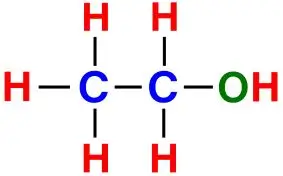
(c) Ethyne : C2H2
Question 12
Ethane, Ethene, Ethanoic acid, Ethyne, Ethanol.
From the above, name
(a) The compound with –OH as the part of it’s structure.
(b) The compound with –COOH as the part of its structure.
(c) Homologue of homologous series with general formula CnH2n.
Answer:
(a) Ethanol (C2H5OH)
(b) Ethanoic acid (CH3COOH)
(c) Ethene (C2H4)
Question 13
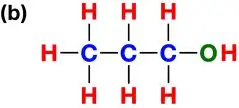
Give the correct IUPAC name and the functional group for each of the compounds whose structural formulae are given below: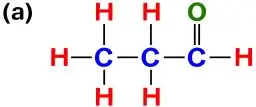
Answer:
(a) IUPAC name: Propanal
Functional group: Aldehyde (–CHO)
(b) IUPAC name: Propanol
Functional group: Alcohol (–OH)
Question 14
(a) Draw the chain isomer of: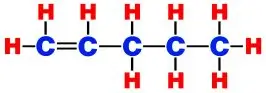
(b) Draw the structure of 2–methylpentane.
Answer:
(a)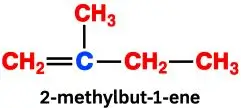
(b)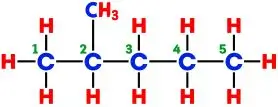
Question 15
Fill in the blanks with the correct words from the brackets:
(a) Alkenes are the (i) …………… (analogous/homologous) series of (ii) …………… (saturated/unsaturated) hydrocarbons. They differ from alkanes due to the presence of (iii) …………… (double/single) bonds. Alkenes mainly undergo (iv) ……………
(addition/substitution) reactions.
(b) The organic compound which undergoes substitution reaction is (v) …………… (C2H2, C2H4, C10H18, C2H6)
(c) Draw the structural formulae of the two isomers of Butane. Give the correct IUPAC name of each isomer.
Answer:
(a) Alkenes are the (i) homologous series of (ii) unsaturated hydrocarbons. They differ from alkanes due to the presence of (iii) double bonds. Alkenes mainly undergo (iv) addition reactions.
(b) The organic compound which undergoes substitution reaction is (v) C2H6.
(c) Butane (C4H10) has two chain isomers.
- Butane (n-butane)
- 2-Methylpropane (iso-butane)
Question 16
Name:
(a) The saturated hydrocarbon containing two carbon atoms.
(b) An alcohol with three carbon atom.
(c) A triple bond hydrocarbon with two carbon atoms.
Answer:
(a) Ethane [C2H6]
(b) Propan-1-ol [C3H7OH]
(c) Ethyne [C2H4]
Question 17
Copy and complete the following table which relates to three homologous series of hydrocarbons:
| General Formula | CnH2n | CnH2n–2 | CnH2n+2 |
| IUPAC name of the homologous series | |||
| Characteristic bond type | Single bonds | ||
| IUPAC name of the first member of the series | Methane | ||
| Type of reaction with chlorine | Addition |
Answer:
| General Formula | CnH2n | CnH2n–2 | CnH2n+2 |
| IUPAC name of the homologous series | Alkene | Alkyne | Alkane |
| Characteristic bond type | Double bonds | Triple bonds | Single bonds |
| IUPAC name of the first member of the series | Ethene | Ethyne | Methane |
| Type of reaction with chlorine | Addition | Addition | Substitution |
Exercise 12 (B) [Page No: 216]
Question 1
State the sources of alkanes.
Answer:
The main sources of alkanes are:
- Natural gas: It contains mainly methane, along with smaller amounts of other alkanes.
- Petroleum: It contains a mixture of various alkanes.
- Coal gas: It may contain small quantities of methane and other hydrocarbons.
Question 2
Methane is a greenhouse gas. Comment
Answer:
Methane is a greenhouse gas because it absorbs outgoing infrared radiation emitted by the Earth’s surface and traps heat in the atmosphere. This contributes to global warming and climate change.
Question 3
Give the general formula of the alkanes.
Answer:
The general formula of alkanes is CnH2n+2,
where n represents the number of carbon atoms in the molecule.
Question 4
Draw the structures of isomers of:
(a) Butane
(b) Pentane
Write the IUPAC and common names of these isomers.
Answer:
(a) Isomers of butane (C4H10):
Butane has two chain isomers.
Isomer 1: n–Butane
- IUPAC name: Butane
- Common name: n–Butane
Isomer 2: Isobutane
- IUPAC name: 2–Methylpropane
- Common name: Isobutane
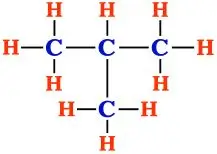
(b) Isomers of Pentane (C5H12)
Pentane has three chain isomers.
Isomer 1: n–Pentane
- IUPAC name: Pentane
- Common name: n–Pentane
- Structural formula:
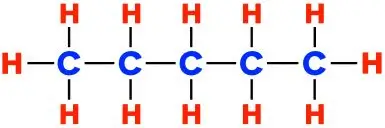
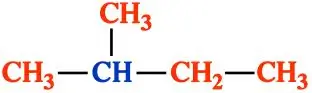
Isomer 2: Isopentane
- IUPAC name: 2–Methylbutane
- Common name: Isopentane
- Structural formula:
Isomer 3: Neopentane
- IUPAC name: 2,2–Dimethylpropane
- Common name: Neopentane
- Structural formula:
Question 5
Write the:
(a) molecular formula.
(b) electron dot formula and
(c) structural formula of methane and ethane.
Answer:
(i) Methane:
(a) Molecular formula: CH4
(b) Electron dot formula: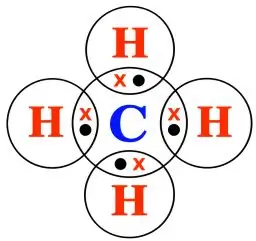
(c) Structural formula: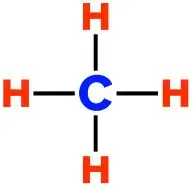
(ii) Ethane:
(a) Molecular formula: C2H6
(b) Electron dot formula: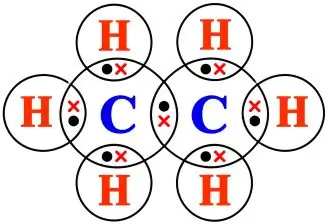
(c) Structural formula:
Question 6
How is:
(a) methane and
(b) ethane prepared in the laboratory?
Answer:
(a) Laboratory preparation of methane:
Methane is prepared by heating a mixture of anhydrous sodium acetate and soda lime.
Chemical equation:
(b) Laboratory preparation of ethane:
Ethane is prepared by heating sodium propionate with soda lime.
Chemical equation:
Question 7
How are methane and ethane prepared from methyl iodide and ethyl bromide?
Answer:
(a) Preparation of methane from methyl iodide:
Methyl iodide is reduced using nascent hydrogen.
Chemical equation:
CH3I + 2[H] → CH4 + HI
(b) Preparation of ethane from ethyl bromide:
Ethyl bromide is reduced using nascent hydrogen.
Chemical equation:
C2H5Br + 2[H] → C2H6 + HBr
Question 8
What is a substitution reaction? Give the reaction of chlorine with ethane and name the product formed.
Answer:
A substitution reaction is a chemical reaction in which an atom or group of atoms in a molecule is replaced by another atom or group of atoms. When ethane reacts with chlorine in the presence of ultraviolet light, one hydrogen atom is replaced by a chlorine atom.
Chemical equation:
Products formed:
- Chloroethane (ethyl chloride), C2H5Cl.
- Hydrogen chloride, HCl.
Question 9
Name the compounds formed when methane burns in:
(a) sufficient air
(b) insufficient air
Give a balanced equation.
Answer:
(a) Complete combustion of methane produces carbon dioxide and water.
Chemical equation:
CH4 + 2O2 [excess] ⟶ CO2 + 2H2O
(b) Incomplete combustion of methane may produce carbon monoxide and water.
Chemical equation:
2CH4 + 3O2 [insufficient] ⟶ 2CO + 4H2O
Question 10
Write the names and the formula of the products formed when:
(a) methane (b) ethane
reacts with (i) chlorine (ii) bromine
Write the chemical equations.
Answer:
(a) Methane:
(i) Reaction with chlorine:
Products: Chloromethane (methyl chloride) and hydrogen chloride.
(ii) Reaction with bromine:
CH4 + Br2 ⟶ CH3Br + HBr
Products: Bromomethane (methyl bromide) and hydrogen bromide.
(ii) Ethane:
(i) Reaction with chlorine:
C2H6 + Cl2 ⟶ C2H5Cl + HCl
Products: Chloroethane (ethyl chloride) and hydrogen chloride.
(ii) Reaction with bromine:
C2H6 + Br2 ⟶ C2H5Br + HBr
Products: Bromoethane (ethyl bromide) and hydrogen bromide.
Question 11
Name the compound prepared from:
(a) Sodium propionate
(b) Methyl iodide and
(c) Ethyl bromide.
Write a balanced equation for the same.
Answer:
(a) Sodium propionate: compound prepared are ethane and sodium carbonate.
(b) Methyl iodide: compound prepared are methane and hydrogen iodide.
(c) Ethyl bromide: compound prepared are ethane and hydrogen bromide.
Question 12
Write the equation for the complete combustion of
(i) Methane
(ii) Ethane
Answer:
(i) Methane:
CH4 + 2O2 [excess] ⟶ CO2 + 2H2O
(ii) Ethane:
2C2H6 + 7O2 [excess] ⟶ 4CO2 + 6H2O
Question 13
Convert:
(a) Methane into chloroform.
(b) Sodium acetate into methane
(c) Methyl iodide into ethane.
(d) Methane to methyl alcohol
Answer:
(a) Methane into chloroform: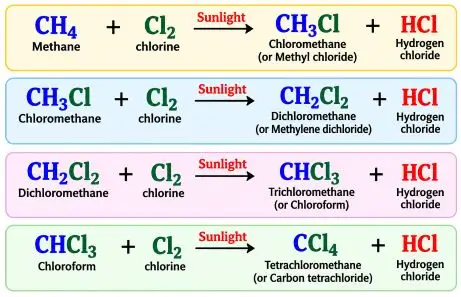
(b) Sodium acetate into methane:
(c) Methyl iodide into ethane:
(d) Methane to methyl alcohol:
Question 14
Give three uses of:
(a) Methane
(b) Ethane
Answer:
(a) Methane:
- It is used as a fuel for cooking and heating in the form of natural gas.
- It is used in the manufacture of hydrogen, which is used to produce ammonia.
- It is used as a raw material for manufacturing methanol and other chemicals.
(b) Ethane:
- It is used as a fuel.
- It is used as a raw material for the manufacture of ethene.
- It is used in the petrochemical industry to manufacture other organic compounds.
Question 15
Under what conditions does ethane get converted to:
(a) ethyl alcohol
(b) acetaldehyde
(c) acetic acid
Answer:
(a) Ethyl alcohol: It is produced when ethane reacts with oxygen at 120 atm pressure and 475 K temperature by passing the mixture through copper tubes.
(b) Acetaldehyde: It is produced when ethane reacts with oxygen in the presence of molybdenum oxide (MoO) as a catalyst.
(c) Acetic acid: It is produced by the oxidation of ethyl alcohol with oxygen in the presence of platinum at 300°C.
Question 16
Using appropriate catalysts, ethane can be oxidised to an alcohol, an aldehyde and an acid. Name the alcohol, aldehyde and acid formed when ethane is oxidised.
Answer:
The compounds formed are:
- Alcohol ⟶ Ethyl alcohol [C2H5OH]
- Aldehyde ⟶ Acetaldehyde [CH3CHO]
- Acid ⟶ Acetic acid [CH3COOH]
Ethane to an alcohol:
Ethane to an aldehyde:
Ethane to an alcohol:
Ethane to an acid:
Exercise 12 (C) [Page No: 220]
Question 1
Write:
(a) molecular formula
(b) electron dot formula and
(c) structural formula of ethene (ethylene).
Answer:
(a) Molecular formula: C2H4
(b) Electron dot formula of ethene: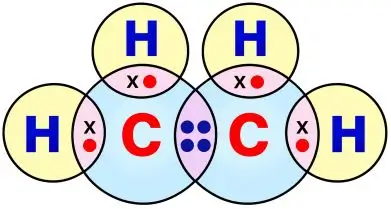
(c) Structural formula of ethene: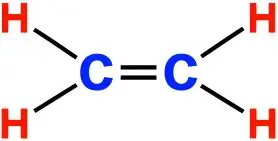
Question 2
The molecules of alkene family are represented by a general formula CnH2n.
Answer the following:
(a) What do n and 2n signify?
(b) What is the name of alkene when n = 4?
(c) What is the molecular formula of alkene when n = 4?
(d) What is the molecular formula of the alkene if there are ten H atoms in it?
(e) What is the structural formula of the third member of the alkene family?
(f) Write the molecular formula of lower and higher homologous of an alkene which contains four carbon atoms.
Answer:
(a) n represents the number of carbon atoms, and2n represents the number of hydrogen atoms.
(b) Butene
(c) C4H8
(d) C5H10
(e) The third member is butene.
Its structural formula is: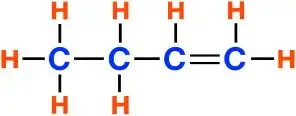
(f) Lower homolog: Propene (C3H6)
Higher homolog: Pentene (C5H10)
Question 3(a)
Distinguish between the saturated hydrocarbon ethane and the unsaturated hydrocarbon ethene by drawing their structural formulae.
Answer:
Structural formula of Ethane [saturated]:
Structural formula of Ethene [unsaturated]:
Question 3(b)
Draw the structures of isomers of butene and write their IUPAC names.
Answer:
Butene has three isomers:
But–1–ene:
But–2–ene: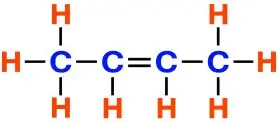
2–Methylprop–1–ene:
Question 4
Give a balanced equation for the lab. preparation of ethylene. How is the gas collected?
Answer:
Ethene is prepared by heating ethanol with excess concentrated sulphuric acid at 170°C.
Collection: Ethene is collected over water by downward displacement of water because it is almost insoluble in water.
Question 5
How is ethene prepared by:
(a) dehydrohalogenation reaction?
(b) dehydration reaction?
Give equations and name the products formed.
Answer:
(a) Dehydrohalogenation reaction:
Products: Ethene, potassium bromide and water.
(b) Dehydration reaction:
Products: Ethene and water.
Question 6
(a) Ethene when reacts with halogens (chlorine and bromine) form saturated products. Name them and write balanced equations.
(b) Give the conditions and the main product formed by hydrogenation of ethene.
Answer:
(a) With chlorine: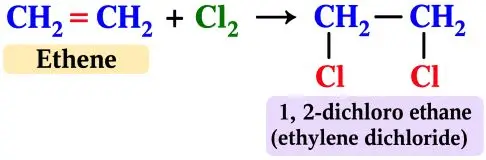
Product: 1,2–Dichloroethane.
With bromine: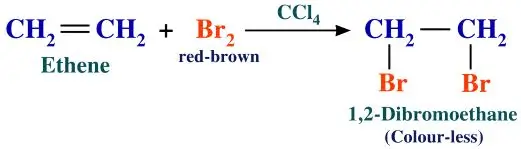
Product: 1,2–Dibromoethane.
(b) Hydrogenation of ethene:
Condition: Hydrogen gas is passed over ethene in the presence of finely divided nickel at about 200°C.
Main product: Ethane.
Question 7
Convert ethanol into ethene using:
(a) solid dehydrating agent
(b) hot conc. H2SO4?
Give only balanced equations.
Answer:
(a) Solid dehydrating agent:
(b) Hot concentrated H2SO4:
Question 8
Write the following properties of ethene:
(a) Physical state
(b) Odour
(c) Density as compared to air
(d) Solubility
Answer:
(a) Physical state: Colourless gas.
(b) Odour: Faintly sweet odour.
(c) Density compared with air: Slightly lighter than air
(d) Solubility: Sparingly soluble in water but highly soluble in organic solvents like alcohol, ether and chloroform.
Question 9
How would you convert:
(a) ethyl bromide into ethene
(b) ethene into 1,2–dibromoethane (c) ethene into ethane
Answer:
(a) Ethyl bromide into ethene:
(b) Ethene into 1,2–dibromoethane:
(c) Ethene into ethane:
Question 10
Give balanced equations when:
(a) ethene is burnt in excess of oxygen.
(b) ethene reacts with chlorine gas.
(c) ethene combines with hydrogen chloride.
(d) a mixture of ethene and hydrogen is passed over nickel at 200°C.
Answer:
(a) Ethene burns in excess oxygen:
(b) Ethene reacts with chlorine gas:
(c) Ethene combines with hydrogen chloride:
(d) Ethene and hydrogen passed over nickel at 200°C:
Question 11
Give the formula and names of A, B, C and D in the following equations: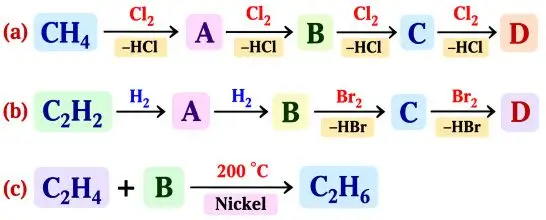
Answer:
(a)
- A — CH3Cl (Chloro methane)
- B — CH2Cl2 (Di-chloromethane)
- C — CHCl3 (Tri-chloro methane)
- D — CCl4 (Carbon tetrachloride)

(b)
- A — C2H4 (ethene)
- B — C2H6 (ethane)
- C — C2H5Br (bromo-ethane)
- D — C2H4Br2 (1,2-Di-bromoethane)

(c) B — H2 (Hydrogen)
Question 12
Write the name and formula of the product formed in each case below:
(a) C2H4 + Cl2 ⟶ ……………
(b) C2H5I + KOH (alc.) ……………
(c) H2C=CH2 ……………
(d) H2C=CH2 + HBr ⟶ ……………
Answer:
(a) C2H4 + Cl2 ⟶ Cl–CH2–CH2–Cl
Product: 1,2–Dichloroethane (Cl–CH2–CH2–Cl)
(b) C2H5I + KOH (alc.) C2H4 + KI + H2O
Product: Ethene (C2H4)
(c) H2C=CH2 CH2(OH)–CH2(OH)
Product: Ethane-1,2-diol [CH2(OH)–CH2(OH)]
(d) H2C=CH2 + HBr ⟶ C2H5Br
Product: Bromoethane (C2H5Br)
Question 13
What do you observe when ethene is passed through alkaline KMnO4 solution?
Answer:
The purple colour of alkaline potassium permanganate solution is decolourised, and ethene is oxidised to ethane-1,2-diol (ethylene glycol).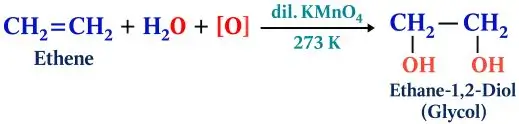
Question 14
Name three compounds formed by ethene and give one use of each compound.
Answer:
- Polythene: Used for making carry bags.
- Ethanol: Used in the preparation of cosmetics and toiletries.
- Oxy-ethylene torch: Used for cutting and welding metals.
Exercise 12 (D) [Page No: 224]
Question 1
What are the sources for alkynes? Give the general formula of alkynes.
Answer:
Natural gas and petroleum are the sources of alkynes.
General formula of alkynes: CnH2n–2
Question 2
Give an example of isomers shown by triple bond hydrocarbons (alkynes) and write their IUPAC names.
Answer:
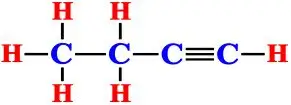
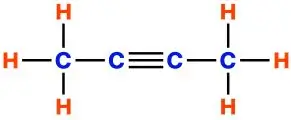
Butyne shows position isomerism.
- IUPAC name: but-1-yne
- IUPAC name: but-2-yne
Question 3
How is ethyne prepared in the laboratory?
(a) Draw a diagram
(b) Give an equation
(c) How is pure dry gas collected?
Answer:
(a) A flask containing calcium carbide is fitted with a dropping funnel containing water. The gas produced is passed through a suitable purification arrangement and collected in an inverted gas jar over water.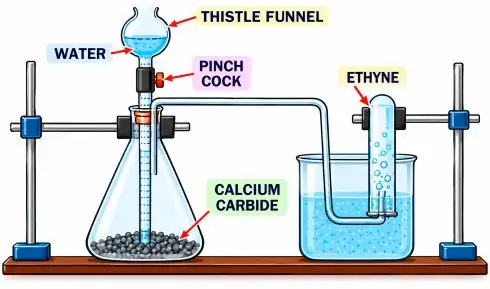
(b) Equation:
(c) Ethyne is collected by downward displacement of water because ethyne is insoluble in water.
Question 4
Give the method of preparation of ethyne by:
1,2–dibromoethane.
Answer:
When 1,2–dibromoethane [ethylene dibromide] is boiled with alcoholic potassium hydroxide, ethyne is formed.
Question 5
Name the organic compound which:
(a) is a tetrahedral molecule.
(b) is a planar molecule.
(c) is a linear molecule.
(d) forms a red precipitate with ammoniacal solution of copper (I) chloride.
(e) is known as paraffin.
(f) is known as olefin.
(g) will give ethyne (acetylene) gas when treated with water.
Answer:
(a) Methane
(b) Ethene
(c) Ethyne
(d) Ethyne
(e) Alkanes
(f) Alkenes
(g) Calcium carbide
Question 6
Classify the following compounds as alkanes, alkenes and alkynes: C3H4, C3H8, C5H8, C3H6
Answer:
- Alkanes — C3H8
- Alkenes — C3H6
- Alkynes — C3H4, C5H8
Question 7
Give a chemical test to distinguish between
(a) saturated and unsaturated compounds
(b) ethane and ethene
(c) ethene (ethylene) and ethyne (acetylene)
Answer:
(a) Saturated and unsaturated compounds:
Add bromine solution in carbon tetrachloride to each compound.
- Unsaturated compounds: Decolourise the reddish-brown bromine solution.
- Saturated compounds: Do not decolourise it under ordinary conditions in the absence of light.
(b) Ethane and ethene:
Add bromine solution in carbon tetrachloride.
- Ethane: No change under ordinary conditions.
- Ethene: Decolourises the bromine solution.
(c) Ethene and ethyne:
Pass the gases through ammoniacal silver nitrate solution.
- Ethene: No precipitate is formed.
- Ethyne: Forms a white precipitate of silver acetylide.
Question 8
Compound X is bubbled through bromine dissolved in carbon tetrachloride (CCl4);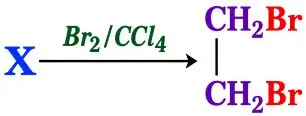
(a) Draw the structure of X.
(b) State your observation during the reaction.
Answer:
(a) Compound ‘X’ is Ethene (H2C=CH2). Its structural formula is shown below:
(b) Brown colour of bromine is discharged.
Question 9
Give balanced equations for the following conversions:
(a) An alkene to an alkane
(b) An alkene to an alcohol
(c) An alkyne to an alkene.
Answer:
(a) An alkene to an alkane: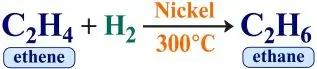
(b) An alkene to an alcohol:
(c) An alkyne to an alkene:
Question 10
Name the products formed and write an equation when ethyne is added to the following in an inert solvent:
(a) chlorine
(b) bromine
(c) iodine
(d) hydrogen
(e) excess of hydrochloric acid.
Answer:
(a) Product: 1,2–dichloroethane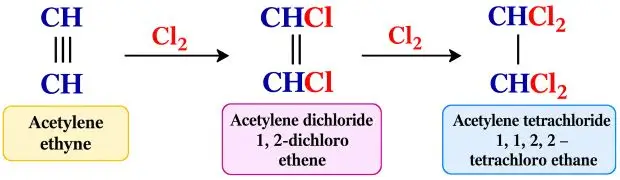
(b) Product: 1,2–dibromoethane
(c) Product: 1,2–diiodoethane
(d) Product: Ethene
(e) Product: 1,1–dichloroethane
Question 11
Substitution reactions are characteristic reactions of …………… (alkynes/alkenes/alkanes).
Answer:
Alkanes
Question 12
(a) Write an equation for the laboratory preparation of:
(i) An unsaturated hydrocarbon from calcium carbide.
(ii) An alcohol from ethyl bromide.
(b) What would you see, when ethyne is bubbled through a solution of bromine in carbon tetrachloride?
(c) Name the addition product formed between ethene and water.
Answer:
(a) (i) Ethyne [C2H2] from Calcium Carbide:
(ii) An alcohol from ethyl bromide:
(b) The reddish-brown colour of bromine solution disappears due to an addition reaction.
(c) Ethanol (ethyl alcohol).
Question 13
Give reasons:
(a) Ethyne is more reactive than ethene.
(b) Ethene is more reactive than ethane.
(c) Hydrocarbons are excellent fuels.
Answer:
(a) The two carbon atoms of ethyne are joined by a triple covalent bond, whereas those of ethene are joined by a double covalent bond. Hence, ethyne has more π electrons available for addition reactions, making it more reactive than ethene.
(b) Ethene is an unsaturated hydrocarbon in which the two carbon atoms are joined by a double covalent bond. Ethane is a saturated hydrocarbon in which the two carbon atoms are joined by a single covalent bond, and all the valencies of carbon are satisfied by hydrogen atoms. The presence of a weaker π bond in ethene makes it more reactive than ethane.
(c) Hydrocarbons have a high calorific value and are easily combustible. Their combustion is an exothermic reaction that releases a large amount of heat energy. Hence, hydrocarbons are excellent fuels.
Question 14
(a) Write balanced equations:
(i) when butane is burnt in oxygen
(ii) for preparation of ethylene from ethyl alcohol.
(b) (i) Convert ethane to tetrabromoethane
(ii) Convert ethyne to ethane.
Answer:
(a) (i) When butane is burnt in oxygen:
C4H10 + 6O2 ⟶ 4CO2 + 5H2O
(b) Preparation of ethylene from ethyl alcohol:
(b) (i) Convert ethane to tetrabromoethane:
(ii) Convert ethyne to ethane:
Question 15
(a) Write the equation for the preparation of carbon tetrachloride from methane.
(b) Draw the structural formula of ethyne.
(c) How is the structure of alkynes different from that of alkenes?
Answer:
(a) Carbon tetrachloride from methane:
(b) Structural formula of ethyne:
(c) Alkynes contain triple bonds while alkenes contain double bonds.
Exercise 12 (E) [Page No: 229]
Question 1
(a) What are alcohols? State their sources.
(b) Give general formulae of monohydric alcohol.
Answer:
(a) Alcohols are organic compounds containing one or more hydroxyl groups (–OH) attached to saturated carbon atoms.
Sources of alcohols:
- Ethanol is obtained by the fermentation of sugars and by the hydration of ethene.
- Methanol was traditionally obtained by the destructive distillation of wood; it is now manufactured industrially from carbon monoxide and hydrogen.
(b) CnH2n+1OH
Question 2
Give the:
(a) dot diagram of first member of alcohol.
(b) abbreviated formula of third member of alcohol.
(c) structure of second member of the alcohol group.
(d) structure of alcohol with 4 carbon atoms.
Answer:
(a) Methyl alcohol (CH3OH) is the first member of alcohol. Its electron dot structure is shown below: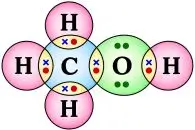
(b) Propyl alcohol : CH3–CH2–CH2–OH
(c) Ethyl alcohol : CH3–CH2–OH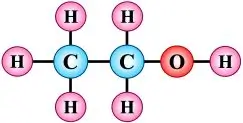
(d) Butyl alcohol : CH3–CH2–CH2–CH2–OH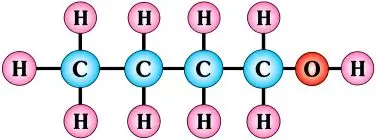
Question 3
State the method of preparation of ethanol:
(a) by hydrolysis of ethene.
(b) by hydrolysis of ethyl bromide.
Answer:
(a) Hydration of Ethene:
Ethanol is produced when ethene is heated with steam at 300°C and 60 atm pressure in the presence of phosphoric acid (H3PO4) as a catalyst.
(b) Hydrolysis of Ethyl Bromide:
Ethanol can be prepared by boiling ethyl bromide (bromoethane) with aqueous sodium hydroxide.
Question 4
Halo alkanes reacts with alkalies to produce alcohol. Give the equation for the preparation of second member of homologous series of alcohol. State under what condition the reaction occur.
Answer:
Ethyl alcohol can be prepared by hydrolysis of haloalkane on reaction with hot and dilute alkali or when an alkyl halide is boiled with aqueous alkalis.
Question 5
(a) How do the boiling point and melting point change in the homologous series of alcohols?
(b) Name the product formed when ethanol reacts with acetic acid. Give an equation.
(c) What is the name given to this type of reaction?
Answer:
(a) The boiling point and melting point increase with increasing molecular weight in the homologous series of alcohols.
(b) Ethanol reacts with ethanoic acid (acetic acid) to form ethyl ethanoate and water.
(c) Esterification
Question 6
Complete and balance the following equations. State the conditions wherever necessary.
(a) H–C≡C–H + H2 ⟶ …………… + H2 ⟶ ……………
(b) C2H4 + Br2 ⟶ ……………
(c) C2H4 + HCl ⟶ ……………
(d) CaC2+ H2O ⟶ ……………
(e) C2H2 + Br2 ⟶ ……………
Answer:
(a) H–C≡C–H + H2 ⟶ H2C=CH2 + H2 ⟶ H3C–CH3
(b) C2H4 + Br2 ⟶ Br–CH2–CH2–Br
(c) C2H4 + HCl ⟶ CH3CH2Cl
(d) CaC2 + 2H2O ⟶ C2H2↑ + Ca(OH)2
(e) C2H2 + Br2 ⟶ C2H2Br2
Question 7
What is the effect of ethanol on human body?
Answer:
Ethanol affects the part of the brain that controls muscular movements. It provides temporary relief from tiredness but can damage the liver and kidneys when consumed in excessive quantities.
Question 8
How are the following obtained:
(a) absolute alcohol
(b) spurious alcohol
(c) methylated spirit ?
Answer:
(a) Absolute alcohol:
Absolute alcohol is nearly pure ethanol, containing very little water. It is obtained by dehydrating rectified spirit, traditionally using quicklime (calcium oxide), followed by distillation.
(b) Spurious alcohol:
Spurious alcohol is illicit or adulterated alcoholic liquor that may contain methanol and other harmful impurities. It can result from improper production or deliberate adulteration and may cause blindness or death.
(c) Methylated spirit:
Methylated spirit is prepared by adding methanol and other denaturing substances to ethanol to make it unfit for drinking.
Question 9
Name the products formed and give appropriate chemical equations for the following:
(a) Sodium reacting with ethyl alcohol.
(b) Ethanol oxidised by acidified potassium dichromate.
Answer:
(a) When sodium reacts with ethyl alcohol (ethanol), sodium ethoxide is formed, and hydrogen gas is liberated.
(b) Ethanol is oxidised to ethanal, which is further oxidised to ethanoic acid (acetic acid) using potassium dichromate (K2Cr2O7) as an oxidising agent.
Question 10
Give the trivial (common) names and the IUPAC names of the following:
(a) C3H6
(b) C2H4
(c) C2H2
(d) CH3OH
(e) C2H5OH
Answer:
| Formula | Common name | IUPAC name |
| (a) C3H6 | Propylene | Propene |
| (b) C2H4 | Ethylene | Ethene |
| (c) C2H2 | Acetylene | Ethyne |
| (d) CH3OH | Methyl alcohol | Methanol |
| (e) C2H5OH | Ethyl alcohol | Ethanol |
Question 11
Ethanol can be oxidised to ethanoic acid. Write the equation and name the oxidising agent.
Answer:
Ethanol under high pressure and low temperature when treated with oxidising agent like acidified potassium dichromate produces ethanoic acid.
Question 12
Name an organic compound which is:
(a) used for illuminating country houses.
(b) used for making a household plastic material.
(c) called ‘wood spirit’.
(d) poisonous and contain OH group.
(e) consumed as a drink.
(f) used in thermometer.
(g) solvent for gums and resins.
(h) dehydrated to produced ethene.
Answer:
(a) Ethyne
(b) Ethene
(c) Methanol
(d) Methanol
(e) Ethanol
(f) Ethanol
(g) Ethanol
(h) Ethanol
Question 13
Ethanol can be converted into ethene which can be changed into ethane. Choose the correct word or phrase from the brackets to complete the following sentences. The conversion of ethanol into ethene is an example of …………… (dehydration, dehydrogenation).
(a) Converting ethanol into ethene requires the use of …………… (conc. HCl, conc. HNO3, conc. H2SO4).
(b) The conversion of ethene into ethane is an example of …………… (hydration, hydrogenation).
(c) The catalyst used in the conversion of ethene into ethane is commonly …………… (iron, nickel, cobalt).
Answer:
(a) The conversion of ethanol into ethene is an example of dehydration.
(b) Converting ethanol into ethene requires the use of conc. H2SO4.
(c) The conversion of ethene into ethane is an example of hydrogenation.
(d) The catalyst used in the conversion of ethene into ethane is commonly nickel.
Question 14
Write the equations for the following lab. preparations:
(a) Ethane from sodium propionate.
(b) Ethene from iodoethane.
(c) Ethyne from calcium carbide.
(d) Methanol from iodomethane.
Answer:
(a) Ethane [C2H6] from sodium propionate:
(b) Ethene from iodoethane:
(c) Ethyne from calcium carbide:
(d) Methanol from iodomethane:
Question 15
Name the compound prepared by each of the following reactions:
(i) C2H5COONa + NaOH ⟶
(ii) CH3I + 2H ⟶
(iii) C2H5Br + KOH (alcoholic solution) ⟶
(iv) CO + 2H2 (Zinc oxide catalyst) ⟶
(v) CaC2 + 2H2O ⟶
Answer:
(i) Ethane
(ii) Methane 
(iii) Ethene (ethylene)
(iv) Methanol
(v) Ethyne (Acetylene)
Question 16
Write the equations for the following reactions:
(a) Calcium carbide and water.
(b) Ethene and water (steam).
(c) Bromoethane and an aqueous solution of sodium hydroxide.
Answer:
(a) Water is added to calcium carbide:
(b) Ethene and water (steam):
(c) Bromoethane and an aqueous solution of sodium hydroxide:
Exercise 12 (F) [Page No: 232]
Question 1
What are carboxylic acids? Give their general formula.
Answer:
An organic compound containing the carboxyl group (–COOH) is known as carboxylic acid. These compounds possess acidic properties.
General formula: CnH2n+1COOH (or RCOOH)
Question 2
Write the names of:
(a) first three members of carboxylic acid series.
(b) three compounds which can be oxidised directly, or in stages to produce acetic acid.
Answer:
(a) First three members are:
- Methanoic acid (HCOOH)
- Ethanoic acid (CH3COOH)
- Propanoic acid (C2H5COOH)
(b) Three compounds are:
- Ethanol (C2H5OH)
- Ethanal (CH3CHO)
- Ethene (C2H4)
Question 3
(a) Give the structural formulae of acetic acid.
(b) IUPAC name of acetic acid.
(c) What is glacial acetic acid?
Answer:
(a) Structural formula of acetic acid: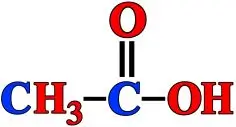
(b) The IUPAC name of acetic acid is ethanoic acid.
(c) Pure acetic acid (100%) is called glacial acetic acid. It freezes at approximately 17°C and forms colourless, ice-like crystals.
Question 4
Vinegar is greyish in colour with a particular taste. Explain.
Answer:
Vinegar is a dilute solution of acetic acid in water. It has a characteristic sour taste due to the presence of acetic acid. Pure vinegar is generally colourless; its greyish appearance may be due to impurities or other dissolved substances.
Question 5
Complete:
(a) Vinegar is prepared by the bacterial oxidation of ……………
(b) The organic acid present in vinegar is ……………
(c) The next higher homologue of ethanoic acid is ……………
Answer:
(a) Vinegar is prepared by the bacterial oxidation of ethanol.
(b) The organic acid present in vinegar is acetic acid.
(c) The next higher homologue of ethanoic acid is propanoic acid.
Question 6
How is acetic acid prepared from
(a) Ethanol
(b) Acetylene
Answer:
(a) Ethanol is oxidised using acidified potassium dichromate or alkaline potassium permanganate to form acetic acid.
(b) Acetylene is first converted to acetaldehyde by passing it through a 40 percent H2SO4 solution at 60°C in the presence of 1% Mercury(II) Sulphate [HgSO4].
Question 7
What do you notice when acetic acid reacts with:
(a) Litmus
(b) Metals
(c) Alkalies
(d) alcohol ?
Answer:
(a) Litmus: Acetic acid turns blue litmus red.
(b) Metals: It reacts with active metals to liberate hydrogen gas and form the corresponding salt.
2CH3COOH + Zn ⟶ (CH3COO)2Zn + H2↑
(c) Alkalies: It neutralises alkalies to form salt and water.
CH3COOH + NaOH ⟶ CH3COONa + H2O
(d) Alcohol: It reacts with alcohol in the presence of concentrated sulphuric acid to form an ester having a fruity smell. This reaction is called esterification.
Question 8
Acetic acid is a typical acid. Write one equation in each case for its reaction with:
(a) a metal
(b) a base/alkali
(c) a carbonate
(d) a bicarbonate
Answer:
(a) Reaction with a metal (sodium):
2CH3COOH + 2Na → 2CH3COONa + H2↑
(b) Reaction with a base (sodium hydroxide):
CH3COOH + NaOH → CH3COONa + H2O
(c) Reaction with a carbonate (sodium carbonate):
2CH3COOH + Na2CO3 → 2CH3COONa + H2O + CO2↑
(d) Reaction with a bicarbonate (sodium bicarbonate):
CH3COOH + NaHCO3 → CH3COONa + H2O + CO2↑
Question 9
What do you observe when acetic acid is added to
(a) sodium bicarbonate
(b) ethyl alcohol in the presence of sulphuric acid.
(c) neutral FeCl3 solution?
Answer:
(a) Brisk effervescence occurs due to the evolution of carbon dioxide gas.
(b) A pleasant fruity smell is produced due to the formation of ethyl ethanoate (ethyl acetate).
(c) A wine red colour is produced due to the formation of ferric acetate.
Question 10
Name:
(a) compound formed when acetic acid and ethanol react together.
(b) substance used to change acetic acid to acetic anhydride.
Answer:
(a) Ethyl ethanoate (ethyl acetate).
(b) Phosphorus pentoxide (P2O5).
Miscellaneous — (A) Multiple Choice Type [Page No: 232]
(Choose the correct answer from the options given below.)
Question 1
Which of the following statements is wrong about alkanes?
(a) They are all saturated hydrocarbon.
(b) They can undergo addition as well as substitution reaction.
(c) They are almost non polar in nature.
(d) On complete combustion give out carbon dioxide and water.
Answer:
(b) They can undergo addition as well as substitution reaction.
Explanation:
Alkanes are saturated hydrocarbons containing only single covalent bonds. They generally undergo substitution reactions, not addition reactions.
Question 2
The organic compound obtained as the end product of the fermentation of sugar solution is:
(a) Methanol (b) Ethanol
(c) Ethane (d) Methanoic acid
Answer:
(b) Ethanol
Explanation:
During fermentation, glucose is converted into ethanol and carbon dioxide by the action of yeast.

Question 3
An organic compound undergoes addition reactions and gives a red colour precipitate with ammoniacal cuprous chloride. Therefore, the organic compound could be:
(a) Ethane (b) Ethene
(c) Ethyne (d) Ethanol
Answer:
(c) Ethyne
Explanation:
Ethyne is an unsaturated hydrocarbon containing a triple bond. It undergoes addition reactions and reacts with ammoniacal cuprous chloride to form a red precipitate of cuprous acetylide.
Question 4
An organic weak acid is:
(a) Formic acid (b) Sulphuric acid
(c) Nitric acid (d) Hydrochloric acid
Answer:
(a) Formic acid
Explanation:
Formic acid (HCOOH) is a weak organic acid. Sulphuric acid, nitric acid and hydrochloric acid are strong mineral acids.
Question 5
The organic compound mixed with ethanol to make it spurious is:
(a) Methanol (b) Methanoic acid
(c) Methanal (d) Ethanoic acid
Answer:
(a) Methanol
Explanation:
Methanol is mixed with ethanol to make it unfit for drinking. Such ethanol is called denatured alcohol. Methanol is highly poisonous and can cause blindness or death.
Question 6
The functional group present in acetic acid is:
(a) Ketonic >C=O (b) Hydroxyl –OH
(c) Aldehydic –CHO (d) Carboxyl –COOH
Answer:
(d) Carboxyl –COOH
Explanation:
Acetic acid (CH3COOH) contains the carboxyl functional group (–COOH), which is responsible for its acidic properties.
Question 7
The unsaturated hydrocarbons undergo:
(a) a substitution reaction
(b) an oxidation reaction
(c) an addition reaction
(d) none of the above
Answer:
(c) An addition reaction
Explanation: Unsaturated hydrocarbons contain double or triple bonds. They undergo addition reactions in which atoms or groups of atoms are added across the multiple bond.
Question 8
The number of C–H bonds in ethane molecule are:
(a) Four (b) Six
(c) Eight (d) Ten
Answer:
(b) Six
Explanation: The molecular formula of ethane is C2H6. It contains six carbon-hydrogen (C–H) bonds.
Question 9
Hydrocarbon which is a greenhouse gas is:
(a) Butane (b) Ethylene
(c) Ethane (d) Methane
Answer:
(d) Methane
Explanation:
Methane (CH4) is a greenhouse gas that traps heat in the Earth’s atmosphere and contributes to global warming.
Question 10
The IUPAC name of acetylene is:
(a) Propane (b) Propyne
(c) ethene (d) ethyne
Answer:
(d) Ethyne
Explanation: The IUPAC name of acetylene is ethyne. It contains two carbon atoms joined by a triple bond.
Question 11
The organic compound having a double carbon-carbon bond is:
(a) C4H10 (b) C5H10
(c) C3H4 (d) C3H8
Answer:
(b) C5H10
Explanation:
Alkenes contain a carbon-carbon double bond (C=C) and have the general formula CnH2n. Among the given options, only C5H10 follows this general formula. Therefore, it represents an alkene containing a carbon-carbon double bond.
Question 12
An example of a cyclic organic compound is:
(a) Pentene (b) Butene
(c) Benzene (d) Propene
Answer:
(c) Benzene
Explanation:
Benzene (C6H6) is a cyclic organic compound containing a six-membered carbon ring with delocalised electrons.
Question 13
The IUPAC name of methyl acetylene is:
(a) Propyne (b) Ethene
(c) Propane (d) Ethyne
Answer:
(a) Propyne
Explanation:
Methyl acetylene contains three carbon atoms and one triple bond. Its IUPAC name is propyne.
Structural formula: CH3–C≡CH
Question 14
The structures of four hydrocarbons are shown below: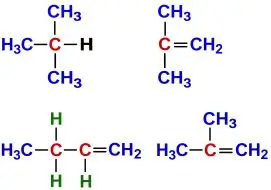
How many isomers of butene are there?
(a) 1 (b) 2 (c) 3 (d) 4
Answer:
(b) 2
Explanation:
On examining the four given structures:
- First structure: 2-Methylpropane (C4H10) – Incorrect, as it is an alkane, not an alkene.
- Second structure: 2-Methylpropene (C4H8) – Correct.
- Third structure: But-1-ene (C4H8) – Correct.
- Fourth structure: 2-Methylpropene (C4H8) – Same as the second structure, so it is not a different isomer.
Therefore, there are 2 distinct isomers of butene among the given structures.
Hence, option (b) 2 is correct.
Question 15
Which of the following is the best reagent to distinguish between ethylene and acetylene ?
- P — Bromine water
- Q — Ammoniacal silver nitrate solution
- R — Acidified potassium dichromate solution
(a) Only P (b) Only Q
(c) Both P and Q (d) Both Q and R
Answer:
(b) Only Q
Explanation:
Ammoniacal silver nitrate distinguishes between ethylene and acetylene.
- P – Bromine water: Both ethylene and acetylene decolourise bromine water because both are unsaturated hydrocarbons.
- Q – Ammoniacal silver nitrate: Acetylene gives a white precipitate of silver acetylide, whereas ethylene does not react.
- R – Acidified potassium dichromate: It is not the standard distinguishing reagent for these two hydrocarbons.
Question 16
Which of the following molecule contains bond between adjacent carbon atoms ?
- P — C4H8
- Q — C3H4
- R — C3H6
(a) Only P (b) Only R
(c) Both P and R (d) Both P and Q
Answer:
(c) Both P and R
Explanation:
- P – C4H8: Can represent an alkene containing a C=C bond.
- Q – C3H4: Can represent an alkyne or a compound with other structures.
- R – C3H6: Can represent an alkene containing a C=C bond.
Assertion – Reason Type
Question 17
Assertion (A): Carbon shows catenation.
Reason (R): Catenation is the property of self linking by covalent bonds.
(a) Both A and R are true and R is the correct explanation of A.
(b) Both A and R are true but R is not the correct explanation of A.
(c) A is true but R is false.
(d) A is false but R is true.
Answer:
(b) Both A and R are true, but R is not the correct explanation of A.
Explanation:
Carbon shows catenation due to its small atomic size and strong C–C covalent bonds, which allow it to form stable long chains, branched chains and rings. Reason (R) only defines catenation but does not explain why carbon exhibits this property.
Question 18
Assertion (A): Alkynes show addition reactions.
Reason (R): Alkanes show substitution reactions.
(a) Both A and R are true and R is the correct explanation of A.
(b) Both A and R are true but R is not the correct explanation of A.
(c) A is true but R is false.
(d) A is false but R is true.
Answer:
Both A and R are true but R is not the correct explanation of A.
Explanation:
- Assertion: True. Alkynes undergo addition reactions because of their triple bonds.
- Reason: True. Alkanes generally undergo substitution reactions.
However, the substitution reaction of alkanes does not explain the addition reaction of alkynes.
Question 19
Assertion (A): The members of a homologous series can be prepared by using the same general method.
Reason (R): The members of a homologous series have the same physical properties.
(a) Both A and R are true and R is the correct explanation of A.
(b) Both A and R are true but R is not the correct explanation of A.
(c) A is true but R is false.
(d) A is false but R is true.
Answer:
(c) A is true but R is false.
Explanation:
- Assertion: True. Members of a homologous series generally have similar chemical properties and can be prepared by similar general methods.
- Reason: False. Members of a homologous series do not have exactly the same physical properties. Their physical properties show a gradual change with increasing molecular mass.
Question 20
Assertion (A): The brown colour of bromine fades when it is added to ethylene.
Reason (R): Ethylene shows substitution reactions.
(a) Both A and R are true and R is the correct explanation of A.
(b) Both A and R are true but R is not the correct explanation of A.
(c) A is true but R is false.
(d) A is false but R is true.
Answer:
(c) A is true but R is false.
Explanation:
- Assertion: True. Bromine water loses its brown colour when added to ethylene.
- Reason: False. Ethylene undergoes addition reactions, not substitution reactions.
Ethylene reacts with bromine to form colourless 1,2–dibromoethane.
Question 21
Assertion (A): Acetylene burns with a sooty flame.
Reason (R): Acetylene contains a greater carbon content.
(a) Both A and R are true and R is the correct explanation of A.
(b) Both A and R are true but R is not the correct explanation of A.
(c) A is true but R is false.
(d) A is false but R is true.
Answer:
(a) Both A and R are true and R is the correct explanation of A.
Explanation:
- Assertion: True. Acetylene burns with a sooty flame.
- Reason: True. Acetylene has a relatively high carbon-to-hydrogen ratio.
Due to its high carbon content, incomplete combustion produces tiny carbon particles, resulting in a sooty flame.
Question 22
Assertion (A): On adding ammoniacal silver nitrate to ethyne, it gives a white precipitate.
Reason (R): The above reaction forms silver acetylide.
(a) Both A and R are true and R is the correct explanation of A.
(b) Both A and R are true but R is not the correct explanation of A.
(c) A is true but R is false.
(d) A is false but R is true.
Answer:
(a) Both A and R are true and R is the correct explanation of A.
Explanation:
- Assertion: True. Ethyne gives a white precipitate with ammoniacal silver nitrate.
- Reason: True. The reaction produces silver acetylide (Ag2C2), which is a white precipitate.
Question 23
Assertion (A): Carboxylic acids react with alcohol in presence of concentrated H2SO4 to produce a fruity smell.
Reason (R): It is due to the formation of an aldehyde.
(a) Both A and R are true and R is the correct explanation of A.
(b) Both A and R are true but R is not the correct explanation of A.
(c) A is true but R is false.
(d) A is false but R is true.
Answer:
(c) A is true but R is false.
Explanation:
- Assertion: True. Carboxylic acids react with alcohols in the presence of concentrated sulphuric acid to produce compounds with a fruity smell.
- Reason: False. The fruity smell is due to the formation of an ester, not an aldehyde.
This reaction is called esterification.
The product is ethyl ethanoate (an ester).
Miscellaneous — (B) Very Short Answer Type [Page No: 232]
Question 1
Match the following reactions in Column I with the products formed in Column II.
| Reaction | Product |
| (a) Dehydration | A. CH3COOC2H5 |
| (b) Halogenation | B. C2H4 |
| (c) Esterification | C. C2H6 |
| (d) Decarboxylation | D. C2H4Br2 |
| (e) Hydration | E. C2H2OH |
Answer:
| Reaction | Product |
| (a) Dehydration | B. C2H4 |
| (b) Halogenation | D. C2H4Br2 |
| (c) Esterification | A. CH3COOC2H5 |
| (d) Decarboxylation | C. C2H6 |
| (e) Hydration | E. C2H5OH |
Question 2
Match the organic compounds in Column I with the categories in Column II.
| Column I | Column II |
| (a) Vinegar | A. Alkane |
(b) 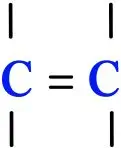 | B. Ester |
(c) 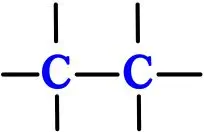 | C. Alkene |
(d) 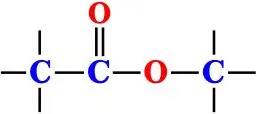 | D. Acetic acid |
(e) 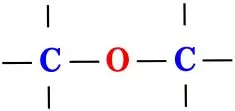 | E. Ether |
Answer:
| Column I | Column II |
| (a) Vinegar | D. Acetic acid |
|
(b) | C. Alkene |
|
(c) | A. Alkane |
|
(d) | B. Ester |
|
(e) | E. Ether |
Question 3
Choose the correct word/phrase from within the brackets to complete the following sentences:
(a) The catalyst used for conversion of ethene to ethane is commonly …………… (nickel/iron/cobalt)
(b) When acetaldehyde is oxidized with acidified potassium dichromate, it forms …………… (ester / ethanol / acetic acid)
(c) Ethanoic acid reacts with ethanol in the presence of concentrated H2SO4, so as to form a compound and water. The chemical
reaction which takes place is called …………… (dehydration/hydrogenation/esterification)
(d) Write the equation for the reaction taking place between 1,2-dibromoethane and alcoholic potassium hydroxide.
(e) The product formed when ethene gas reacts with water in the presence of sulphuric acid …………… (ethanol / ethanal / ethanoic acid)
Answer:
(a) Nickel
(b) Acetic acid
(c) Esterification
(d)
(e) Ethanol
Question 4
From the following organic compounds given below, choose one compound in each case which relates to the description [a] to [d]:
[Ethyne, ethanol, acetic acid, ethene, methane].
(a) An unsaturated hydrocarbon used for welding purposes …………….
(b) An organic compound whose functional group is carboxyl ……………
(c) A hydrocarbon which on catalytic hydrogenation gives a saturated hydrocarbon ……………
(d) …………… used as a thermometric liquid .
Answer:
(a) Ethyne
(b) Acetic acid
(c) Ethene
(d) Ethanol
Question 5
Name:-
(a) Process by which ethane is obtained from ethene.
(b) A hydrocarbon which contributes towards the greenhouse effect.
(c) The distinctive reaction that takes place when ethanol is treated with acetic acid.
(d) The property of elements by virtue of which atoms of the element can link to each other in the form of a long chain or ring structure.
(e) The reaction when an alkyl halide is treated with alcoholic potassium hydroxide.
(f) The hydrocarbons containing 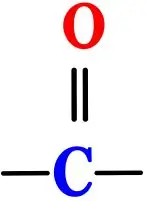 functional group.
Answer:
(a) Catalytic hydrogenation (addition)
(b) Methane
(c) Esterification
(d) Catenation
(e) Dehydrohalogenation
(f) ketones
Question 6
Identify the functional group in:-
(a) Dimethyl ether
(b) Propanone
Answer:
(a) Dimethyl ether: Ether group (–O–)
(b) Propanone: Ketone group (>C=O)
Question 7
Give the IUPAC names of: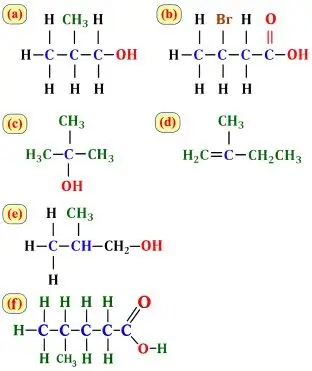
Answer:
(a) 2-Methylpropan-1-ol
(b) 3-Bromobutanoic acid
(c) 2-Methylpropan-2-ol
(d) 2-Methylbut-1-ene
(e) 2-Methylpropan-1-ol
(f) 4-methylpentanoic acid
Miscellaneous — (C) Short Answer Type [Page No: 232]
Question 1
(a) Why is pure acetic acid known as glacial acetic acid?
(b) Give a chemical equation for the reaction between ethyl alcohol and acetic acid.
Answer:
(a) Pure acetic acid freezes at about 16.6°C and forms ice-like crystals. Hence, it is called glacial acetic acid.
(b) Reaction between ethyl alcohol and acetic acid:
Question 2
Find the odd one out and explain:
C3H8, C5H10, C2H6, CH4
Answer:
C5H10 is the odd one out because it is an unsaturated hydrocarbon (alkene), whereas the others are saturated hydrocarbons (alkanes).
Question 3
(a) Define isomerism
(b) Give the IUPAC name of:
(i) the isomer C4H10 which has a branched chain.
(ii) 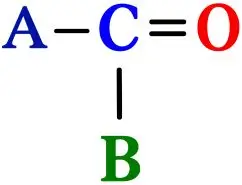
where C stands for carbon, O for oxygen, A for hydrogen and B for ethyl group.
Answer:
(a) The phenomenon in which two or more compounds have the same molecular formula but different structural arrangements is called isomerism.
Example : Isomers of pentane are (i) n pentane, (ii) isopentane and (iii) neo-pentane
(b) (i) The IUPAC name of the branched isomer of butane (C4H10) is 2-methyl propane.
(ii) Substituting A = –H and B = –C2H5 (–CH2CH3):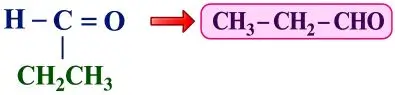
Name: Propanal
Question 4
Write equation of ethyl bromide with:-
(a) aqueous NaOH
(b) alcoholic NaOH
Answer:
(a) Aqueous NaOH:
(b) alcoholic NaOH:
Equation 5
Write balanced chemical equations for the following:-
(a) Monochloro ethane is hydrolysed with aqueous KOH.
(b) A mixture of sodalime and sodium acetate is heated.
(c) Ethanol under high pressure and low temperature is treated with acidified potassium dichromate.
(d) Water is added to calcium carbide.
(e) Ethanol reacts with sodium at room temperature.
Answer:
(a) Monochloro ethane is hydrolysed with aqueous KOH:
(b) A mixture of sodalime and sodium acetate is heated:
(c) Ethanol under high pressure and low temperature is treated with acidified potassium dichromate:
(d) Water is added to calcium carbide:
(e) Ethanol reacts with sodium at room temperature:
Question 6
Give chemical equation for:
(a) The laboratory preparation of methane from sodium acetate.
(b) The reaction of one mole of ethene with one mole of chlorine gas.
(c) The preparation of ethyne from 1,2-dibromoethane.
(d) Preparation of ethane from sodium propionate.
(e) preparation of ethanol from monochloroethane and aq. sodium hydroxide.
Answer:
(a) The laboratory preparation of methane from sodium acetate:
(b) The reaction of one mole of ethene with one mole of chlorine gas:
(c) The preparation of ethyne from 1,2-dibromoethane:
(d) Preparation of ethane from sodium propionate:
(e) preparation of ethanol from monochloroethane and aq. sodium hydroxide:
Question 7
Distinguish ethane and ethene (using alkaline potassium permanganate solution).
Answer:
Ethene decolourises the purple alkaline KMnO4 solution, whereas ethane does not.
Question 8
The structures of six organic compounds are shown: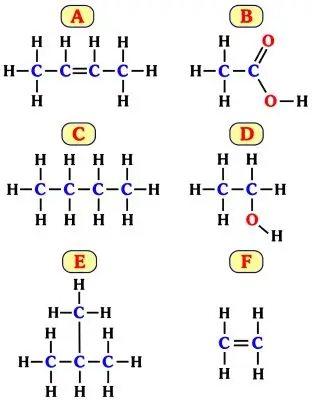
(a) Identify two of the compounds that are members of the same homologous series but are not isomers.
(b) Which two compounds are isomers of each other?
(c) F can be prepared from D. Give a chemical equation for the reaction.
Answer:
(a) A and F
(b) C and E
(c)
Miscellaneous— (D) Long Answer Type [Page No: 232]
Question 1
A compound X when treated with an organic acid Y (having vinegar like smell) in the presence of the acid Z, forms a compound P which has a fruity smell.
(a) Identify X, Y and Z.
(b) Write structural formula of X and Y.
(c) What type of compound is P?
(d) Name the above reaction.
(e) If compound X and Y both have 2 carbon atoms. Write the reaction.
Answer:
(a) X, Y and Z are:
- X – Ethanol (C2H5OH)
- Y – Ethanoic acid (CH3COOH)
- Z – Conc. sulphuric acid (H2SO4)
(b) The structural formulae are shown below:
- Ethyl alcohol (X):
- Acetic acid (Y):
(c) Ester
(d) Esterification
(e) The reaction is given below:
Question 2
Draw the structural formula for each of the following:-
(a) Ethanoic acid
(b) But–2–yne
(c) Methanoic acid
(d) Ethanal
(e) Ethyne
(f) Acetone
(g) 2–methyl propane
(h) An isomer of n-butane
(i) 2–propanol
(j) Ethanol
(k) 1–propanal
(l) ethanoic acid
(m) 1,2–dichloroethane
Answer:
(a) Ethanoic acid: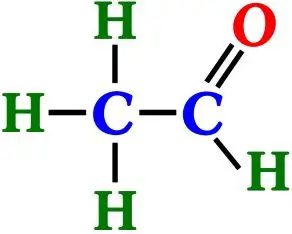
(b) But–2–yne: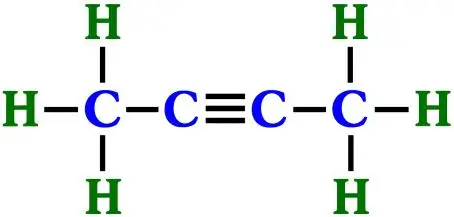
(c) Methanoic acid: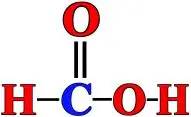
(d) Ethanal: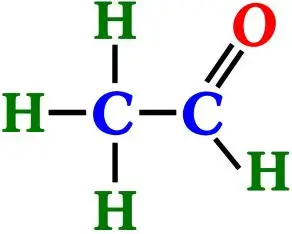
(e) Ethyne:
(f) Acetone: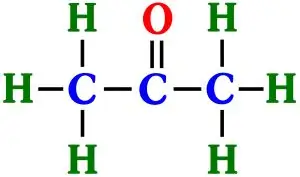
(g) 2–methyl propane: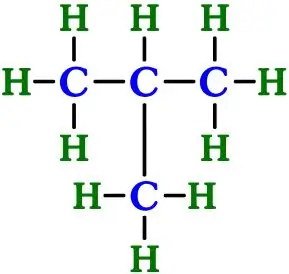
(h) An isomer of n-butane:
(i) 2–propanol: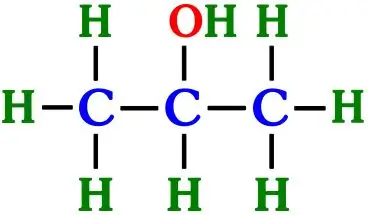
(j) Ethanol: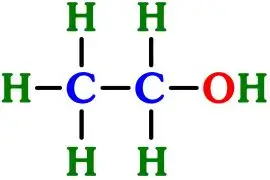
(k) 1–propanal: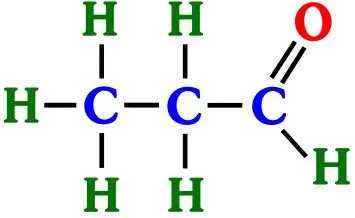
(l) ethanoic acid:
(m) 1,2–dichloroethane: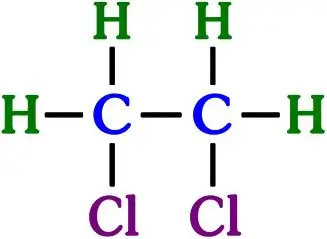
Question 3
Give balanced chemical equation for the following conversions:-
(a) Ethanoic acid to ethyl ethanoate.
(b) Calcium carbide to ethyne
(c) Sodium ethanoate to methane.
(d) Ethyl chloride to ethyl alcohol
(e) Ethyl chloride to ethene
(f) Ethene to ethyl alcohol
(g) Ethyl alcohol to ethene
Answer:
(a) Ethanoic acid to ethyl ethanoate:
(b) Calcium carbide to ethyne:
(c) Sodium ethanoate to methane:
(d) Ethyl chloride to ethyl alcohol:
(e) Ethyl chloride to ethene:
(f) Ethene to ethyl alcohol:
(g) Ethyl alcohol to ethene:
Question 4
Distinguish between ethane, ethene and ethyne on the basis of their:
(a) Structure and
(b) Chemical test.
Answer:
(a)
| Compound | Structure | Type of bond |
| Ethane | CH3–CH3 | Single bond (C–C) |
| Ethene | CH2=CH2 | Double bond (C=C) |
| Ethyne | HC≡CH | Triple bond (C≡C) |
(b) Chemical test:
- Ethane: Does not decolourise bromine solution.
- Ethene: Decolourises bromine solution due to addition reaction.
- Ethyne: Decolourises bromine solution due to addition reaction.
Question 5
An organic compound A is warmed with conc. H2SO4 to form B. On adding hydrogen to B in presence of a Nickel compound, C is formed. One mole of C on combustion forms two moles of carbon dioxide and three moles of water.
(a) Identify A, B and C.
(b) Write the chemical equations for the reactions involved.
Answer:
(a) Identification:
- A: Ethanol (C2H5OH)
- B: Ethene (C2H4)
- C: Ethane (C2H6)
(b) Chemical equations:
- Ethanol to ethene:
- Ethene to ethane:
- Combustion of ethane:

Question 6
Compound A is bubbled through bromine dissolved in carbon tetrachloride and the product formed is CH2Br–CH2Br.
(a) Draw the structural formula of A.
(b) What type of reaction has A undergone.
(c) What is your observation?
(d) Name (not formula) the compound formed when steam reacts with A in the presence of phosphoric acid.
(e) What is the procedure for converting the product of (d) back to A?
Answer:
(a) Compound A is Ethene (H2C=CH2). It’s structural formula is shown below:
(b) Addition reaction (halogenation)
(c) The reddish-brown colour of bromine solution disappears.
(d) Ethanol
(e) Ethanol can be converted into ethene, by dehydrating it with concentrated H2SO4 at 170°C.
Question 7
When mangoes are kept in a basket, a small sachet containing a white crystalline powder is also kept which induces ripening.
(a) Name the chemical powder in the sachet.
(b) When this powder comes in contact with moisture, it releases a gas. Name the gas.
(c) Give a balanced chemical equation for the reaction in (b).
Answer:
(a) Calcium carbide (CaC2)
(b) Ethyne (acetylene)
(c)
Question 8
Molecular formula of an organic compound A is C3H8O. It has a functional group attached to the first carbon atom. This compound reacts with sodium at room temperature evolving hydrogen gas. Identify compound A and draw its structure.
Answer:
Compound A is propan–1–ol (C3H7OH). Its molecular formula is C3H8O, and its hydroxyl group (–OH) is attached to the first carbon atom. It reacts with sodium to release hydrogen gas. Therefore, the functional group is hydroxyl (–OH).
Structure: 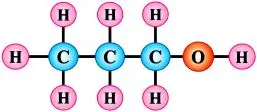
Question 9
Equal volumes of methane and chlorine react together to form an organic compound. Draw the structure of this organic compound.
Answer:
Equal volumes of methane (CH4) and chlorine (Cl2) react in the presence of sunlight/UV light,chloromethane (CH3Cl) is formed.
Structural formula: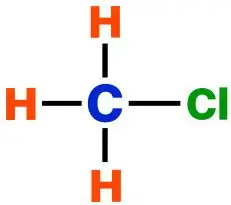
Question 10
One mole of hydrocarbon X on combustion produces four moles of carbon dioxide and four moles of water.
(a) Write the equation for the combustion reaction.
(b) Draw the structure of X.
Answer:
(a) Combustion reaction:
On combustion, 1 mole of hydrocarbon X produces 4 moles of carbon dioxide and 4 moles of water. Therefore, X contains 4 carbon atoms and 8 hydrogen atoms. Hence, its molecular formula is C4H8.
C4H8 + 6O2 ⟶ 4CO2 + 4H2O
(b) X is butene. Its structural formula is shown below:
Download ICSE Class 10 Chemistry Chapter 12 Organic Chemistry Solutions PDF
Students can use the chapter-wise Selina textbook solutions available on Rohit Academy for effective learning and revision.
Explore the complete Organic Chemistry solutions and practise all textbook questions to improve your preparation for the ICSE Class 10 Chemistry examination.
Why Are Selina Organic Chemistry Solutions Important?
Practising textbook questions is essential for scoring good marks in the ICSE Class 10 Chemistry examination. Selina solutions help students understand the correct approach to answering different types of questions.
Benefits of these solutions:
- Easy-to-understand explanations.
- Step-by-step answers to textbook questions.
- Important chemical equations and reactions.
- Proper chemical formulae and structures.
- Helpful for quick revision.
- Useful for school examinations and ICSE board preparation.
Conclusion
ICSE Class 10 Chemistry Chapter 12 Organic Chemistry is an important chapter that requires a clear understanding of concepts, chemical reactions and organic compound structures. Practising Selina textbook solutions regularly will help students develop confidence and improve their Chemistry preparation.
For more ICSE Class 10 Chemistry notes, textbook solutions, important questions and study materials, keep visiting Rohit Academy.
You can also visit:
ICSE Class 10 Chemistry Selina Solutions
| ☛ ICSE Class 10 Chemistry Chapter 1 – Periodic Table Selina Solutions |
| ☛ ICSE Class 10 Chemistry Chapter 2 – Chemical Bonding Selina Solutions |
| ☛ ICSE Class 10 Chemistry Chapter 3 – Acids, Bases and Salts Selina Solutions |
| ☛ ICSE Class 10 Chemistry Chapter 4 – Analytical Chemistry Selina Solutions |
| ☛ ICSE Class 10 Chemistry Chapter 5 – Mole Concept and Stoichiometry Selina Solutions |
| ☛ ICSE Class 10 Chemistry Chapter 6 – Electrolysis Selina Solutions |
| ☛ ICSE Class 10 Chemistry Chapter 7 – Metallurgy Selina Solutions |
| ☛ ICSE Class 10 Chemistry Chapter 8 – Hydrogen Chloride Selina Solutions |
| ☛ ICSE Class 10 Chemistry Chapter 9 – Ammonia Selina Solutions |
| ☛ ICSE Class 10 Chemistry Chapter 10 – Nitric Acid Selina Solutions |
| ☛ ICSE Class 10 Chemistry Chapter 11 – Sulphuric Acid Selina Solutions |
| ☛ ICSE Class 10 Chemistry Chapter 12 – Organic Chemistry Selina Solutions |
Official Websites:
Students can visit the official CISCE website for more details and updates.