Introduction
Motion is an important concept in Physics that helps us understand how objects move from one place to another. In ICSE Class 7 Physics Chapter 2 Motion, students learn about rest and motion, types of motion, speed, distance, time, and graphical representation of motion. To help students prepare effectively, we have provided complete Selina Solutions with simple explanations and accurate answers.
These solutions are designed according to the latest ICSE syllabus and help students understand concepts clearly while improving problem-solving skills.
Study Support by Rohit Academy
Rohit Academy offers expert-curated ICSE Class 7 Physics Study Materials including ICSE Motion Selina Solutions, diagrams, and key formulas for better understanding.
You can also visit:
| ☛ ICSE Class 7 Physics Chapter 1: Motion Notes |
| ☛ ICSE Class 7 Physics |
| ☛ ICSE Class 7 Chemistry |
| ☛ ICSE Class 7 Mathematics |
| ☛ ICSE Class 7 Biology |
(A) Objective Type Questions
Question 1
Choose the correct answer from the multiple choices given below.
Question 1(a)
A book lying on a table is an example of:
(i) a body at rest
(ii) a body in motion
(iii) a body neither at rest nor in motion
(iv) none of these.
Answer:
(i) a body at rest
Explanation:
A body is said to be at rest when its position does not change with time with respect to its surroundings. Since the book remains in the same position on the table, it is at rest.
Question 1(b)
The motion of a pendulum is:
(i) rotatory
(ii) oscillatory
(iii) curvilinear
(iv) rectilinear
Answer:
(ii) oscillatory
Explanation:
A pendulum moves to and fro about its mean position repeatedly. This type of motion is called oscillatory motion.
Question 1(c)
A car moving on a straight road is an example of:
(i) rotatory motion
(ii) rectilinear motion
(iii) oscillatory motion
(iv) periodic motion
Answer:
(ii) rectilinear motion
Explanation:
Motion along a straight line is called rectilinear motion. Since the car moves on a straight road, its motion is rectilinear.
Question 1(d)
A ball falls down vertically. Its motion is:
(i) periodic (ii) linear
(iii) circular (iv) vibratory
Answer:
(ii) linear
Explanation:
When a body moves in a straight line, the motion is called linear motion. A falling ball moves vertically downward in a straight path.
Question 1(e)
If a body covers equal distances in equal intervals of time, the motion is said to be:
(i) uniform (ii) non-uniform
(iii) oscillatory (iv) rotatory
Answer:
(i) uniform
Explanation:
In uniform motion, a body covers equal distances in equal intervals of time, no matter how small the intervals are.
Question 1(f)
A boy goes from his house to school by bus at a speed of 20 km h–1 and returns back through the same route at a speed of 30 km h–1. The average speed of his journey is :
(i) 24 km h–1 (ii) 25 km h–1
(iii) 30 km h–1 (iv) 20 km h–1
Answer:
(i) 24 km h–1
Explanation:
When equal distances are covered at different speeds:
Average speed \(=\frac{2xy}{x\ +\ y}\)
Here,
● x = 20 km h–1
● y = 30 km h–1
Average speed \(=\frac{2\ \times\ 20\ \times\ 30}{30\ +\ 20}=\frac{1200}{50}\) = 24 km h–1
Therefore, the average speed is 24 km h–1.
Question 1(g)
The earth attracts a body of mass 1 kg with a force of 10 N. The mass of a boy is 50 kg. His weight will be:
(i) 50 kg (ii) 500 N
(iii) 50 N (iv) 5 N
Answer:
(ii) 500 N
Explanation:
Weight is given by:
W = m × g
Where:
● m = 50 kg
● g = 10 N kg–1
W = 50 × 10 = 500 N Therefore, the weight of the boy is 500 N.
Question 1(h)
A cyclist taking a turn on a road is an example of …………… motion.
(i) rectilinear (ii) translatory
(iii) curvilinear (iv) circular
Answer:
(iii) curvilinear
Explanation:
When a body moves along a curved path, the motion is called curvilinear motion. A cyclist taking a turn follows a curved path.
Question 1(i)
In …………… motion, the distance of a point on the body remains constant from a fixed reference point.
(i) vibratory (ii) rectilinear
(iii) curvilinear (iv) circular
Answer:
(iv) circular
Explanation:
In circular motion, a body moves along a circular path and remains at a constant distance (radius) from a fixed point called the centre.
Assertion Reason Type
Question 2
The following questions are Assertion-Reason based questions. Choose the answer based on the codes given below.
Question 2(a)
Assertion (A): Weight is equal to mass in deep space.
Reason (R): Weight depends on gravitational force.
(i) Both A and R are true and R is the correct explanation of A
(ii) Both A and R are true and R is not the correct explanation of A
(iii) A is true but R is false
(iv) A is false but R is true
Answer:
(iv) A is false but R is true
Explanation:
In deep space, weight becomes nearly zero due to absence of gravity, but mass remains unchanged. Therefore, weight is not equal to mass. Weight depends on gravitational force.
Question 2(b)
Assertion (A): If a moving body travels equal distances in equal intervals of time, its motion is said to be uniform.
Reason (R): For uniform motion, the speed of the moving body remains constant.
(i) Both A and R are true and R is the correct explanation of A
(ii) Both A and R are true and R is not the correct explanation of A
(iii) A is true but R is false
(iv) A is false but R is true
Answer:
(i) Both A and R are true and R is the correct explanation of A
Explanation:
Uniform motion means covering equal distances in equal intervals of time. This happens because the speed remains constant.
Fill in the blanks
Question 3
Fill in the blanks:
(a) Two boys cycling on the road with the same speed are …………… relative to each other.
(b) The motion in a …………… is rectilinear motion.
(c) One to and fro motion of a clock pendulum takes time = …………… .
(d) 36 km h–1 = …………… m s–1.
(e) Total distance travelled = …………… x total time taken.
(f) The weight of a girl is 36 kgf. Her mass will be …………… .
(g) The weight of a body is measured using …………… .
Answer:
(a) Two boys cycling on the road with the same speed are at rest relative to each other.
(b) The motion in a straight line is rectilinear motion.
(c) One to and fro motion of a clock pendulum takes time = 2 s .
(d) 36 km h–1 = 10 m s–1.
(e) Total distance travelled = average speed x total time taken.
(f) The weight of a girl is 36 kgf. Her mass will be 36 kg .
(g) The weight of a body is measured using spring balance .
True or False
Question 4
Write true or false for each statement:
(a) Two trains going in opposite directions with the same speed are at rest relative to each other.
(b) A ball is thrown vertically upwards. Its motion is uniform throughout.
(c) The motion of a train starting from one station and reaching at another station is non-uniform.
(d) A motion which repeats itself after a fixed interval of time is called periodic motion.
(e) A ball thrown by a boy from a roof-top has oscillatory motion.
(f) Mass has both magnitude and direction.
(g) Weight always acts vertically downwards.
(h) Mass varies from place to place but weight does not.
Answer:
(a) False
Correct Statement : Two trains going in opposite directions with the same speed are at motion relative to each other.
(b) False
Correct Statement : A ball is thrown vertically upwards. Its motion is non-uniform throughout.
(c) True
(d) True
(e) False
Correct Statement : A ball thrown by a boy from a roof-top has curvilinear motion.
(f) False
Correct Statement : Mass has only magnitude.
(g) True
(h) False
Correct Statement : Weight varies from place to place but mass does not.
Match the Columns
Question 5
Match the following:
| Column A | Column B |
| (a) Circular motion | (i) a running fan |
| (b) Periodic motion | (ii) a car moving in a market |
| (c) Vibratory motion | (iii) movement of the hands of a clock |
| (d) Rotatory motion | (iv) motion of wire of a guitar |
| (e) Non-uniform motion | (v) motion of pendulum of a clock |
Answer:
| Column A | Column B |
| (a) Circular motion | (iii) movement of the hands of a clock |
| (b) Periodic motion | (v) motion of pendulum of a clock |
| (c) Vibratory motion | (iv) motion of wire of a guitar |
| (d) Rotatory motion | (i) a running fan |
| (e) Non-uniform motion | (ii) a car moving in a market |
(B) Short Answer Type Questions
Question 1
Comment on the statement ‘rest and motion are relative terms’. Give an example.
Answer:
Rest and motion are relative terms because an object may be at rest with respect to one object and in motion with respect to another object.
Example: A person sitting in a moving train is at rest relative to the train but in motion relative to the platform.
Question 2
Fill in the blanks using one of the words: at rest, in motion.
(a) A person walking in a compartment of a stationary train is …………… relative to the compartment and is …………… relative to the platform.
(b) A person sitting in a compartment of a moving train is …………… relative to the other person sitting by his side and is …………… relative to the platform.
Answer:
(a) A person walking in a compartment of a stationary train is in motion relative to the compartment and is in motion relative to the platform.
(b) A person sitting in a compartment of a moving train is at rest relative to the other person sitting by his side and is in motion relative to the platform.
Question 3
Name five different types of motion you know.
Answer:
The five different types of motion are:
- Translatory motion
- Rotatory motion
- Circular motion
- Vibratory motion
- Oscillatory motion
Question 4
What do you mean by translatory motion? Give one example.
Answer:
When every point of a body moves through the same distance in the same interval of time, the motion is called translatory motion.
Examples: A car moving on a road.
Question 5
What is rotatory motion? Give two examples.
Answer:
Rotatory motion is the motion in which a body rotates about a fixed axis.
Examples:
- Blades of a fan
- Wheel of a bicycle
Question 6
What is meant by circular motion? Give one example.
Answer:
The motion of a body along a circular path is called circular motion.
Example: Motion of a satellite around the earth.
Question 7
How does rotatory motion differ from circular motion?
Answer:
| Rotatory Motion | Circular Motion |
| In rotatory motion, a body rotates about its own axis. | In circular motion, a body moves along a circular path around another point or axis. |
| Example: Earth spinning on its axis. | Example: Earth revolving around the Sun. |
Question 8
What is vibratory motion? Give one example.
Answer:
Vibratory motion is the motion in which a body moves to and fro about its mean position.
Example: A pendulum of a clock.
Question 9
What is random motion? Give an example.
Answer:
The motion of an object which takes path in no specific direction is called random motion.
Example: Motion of smoke particles in air.
Question 10
Name the type/types of motion being performed by each of the following:
(a) Vehicle on a straight road
(b) Blades of an electric fan in motion
(c) Pendulum of a wall clock
(d) Smoke particles from chimney
(e) Hands of a clock
(f) Earth around the Sun
(g) A spinning top
Answer:
(a) Vehicle on a straight road — Rectilinear motion
(b) Blades of an electric fan in motion — Rotatory motion
(c) Pendulum of a wall clock — Oscillatory motion and Periodic motion
(d) Smoke particles from chimney — Random motion
(e) Hands of a clock — Circular motion
(f) Earth around the Sun — Circular motion, Periodic motion
(g) A spinning top — Rotatory motion
Question 11
State the types of motion of the following:
(a) The needle of a sewing machine
(b) The wheel of a bicycle
(c) The drill machine
(d) The carpenter’s saw
Answer:
(a) The needle of a sewing machine — Periodic motion
(b) The wheel of a bicycle — Translatory and rotatory motion
(c) The drill machine — Translatory and rotatory motion
(d) The carpenter’s saw — Translatory and oscillatory motion
Question 12
Define the term weight and state its S.I. unit.
Answer:
The weight of the body on earth is the force with which earth attracts the body. The S.I. unit of weight is newton (N).
Question 13
How are the units of weight, kgf and newton related?
Answer:
1 kgf = 9.8 N
Question 14
Which quantity : mass or weight, does not change by change of place?
Answer:
Mass does not change by change of place.
Question 15
State which of the quantities, mass or weight is always directed vertically downwards.
Answer:
Weight is always directed vertically downwards.
(C) Long Answer Type Questions
Question 1
Explain the meaning of the terms rest and motion.
Answer:
A body is said to be at rest if it does not change its position with respect to its surroundings with time.
A body is said to be in motion if it changes its position with respect to its surroundings with time.
Question 2
Explain the meanings of:
(i) rectilinear motion, and
(ii) curvilinear motion.
Give one example of each.
Answer:
(i) The motion of a body in a straight line is called rectilinear or linear motion.
Example: A car moving on a straight road.
(ii) If the motion of a body is along a curved path, it is said to be a curvilinear motion.
Example: The motion of a cycle while taking a turn on the road.
Question 3
Explain oscillatory motion by giving one example.
Answer:
Oscillatory motion is the motion in which a body moves to and fro repeatedly about its mean position.
Example: The motion of a simple pendulum.
Question 4
Differentiate between periodic and non-periodic motions by giving an example of each.
Answer:
| Periodic Motion | Non-periodic Motion |
| Motion which repeats itself after equal intervals of time. | Motion which does not repeat itself after equal intervals of time. |
| Example: Revolution of the Earth around the Sun. | Example: Motion of a car on a crowded road. |
Question 5
Give two examples to illustrate that a body can have two or more types of motion simultaneously.
Answer:
- A rolling bicycle wheel has both rotatory motion and translatory motion.
- The Earth has rotatory motion about its axis and circular motion around the Sun simultaneously.
Question 6
Distinguish between uniform and non-uniform motions, giving an example of each.
Answer:
| Uniform Motion | Non-uniform Motion |
| A body covers equal distances in equal intervals of time. | A body covers unequal distances in equal intervals of time. |
| Speed remains constant. | Speed changes with time. |
| Example: A train moving at constant speed. | Example: A car moving in city traffic. |
Question 7
How do you determine the average speed of a body in non-uniform motion?
Answer:
Average speed is determined by dividing the total distance travelled by the total time taken.
Average speed \(=\frac{Total\ distance\ \operatorname{travelled}}{Total\ time\ taken}\)
Question 8
State three differences between mass and weight.
Answer:
| Mass | Weight |
| Mass is the quantity of matter contained in a body. | Weight is the force with which the Earth attracts a body. |
| Mass remains constant everywhere. | Weight changes from place to place. |
| It is measured by a beam balance. | It is measured by a spring balance. |
| S.I. unit is kilogram (kg). | S.I. unit is newton (N). |
(D) Numericals
Question 1
A car covers a distance of 160 km between two cities in 4 h. What is the average speed of the car?
Solution:
Given,
Total distance travelled = 160 km
Total time taken = 4 h
Average speed \(=\ \frac{Total\ distance\ \operatorname{travelled}}{Total\ time\ taken}=\ \frac{160}{4}\) = 40 km h–1
Therefore, the average speed of the car is 40 km h–1.
Question 2
A train travels a distance of 300 km with an average speed of 60 km h–1. How much time does it take to cover the distance?
Solution:
Given,
Distance travelled = 300 km
Average speed = 60 km h–1
Time taken \(=\ \frac{\operatorname{Distance}}{Speed}=\ \frac{300}{60}\) = 5 h
Therefore, the train takes 5 hours to cover the distance.
Question 3
A boy travels with an average speed of 10 m s–1 for 20 min. How much distance does he travel?
Solution:
Given,
Average speed = 10 m s–1
Time taken = 20 min
Convert time into seconds: 20 min = 20 × 60 = 1200 s
Distance travelled = Speed × Time
= 10 × 1200
= 12000 m
Therefore, the boy travels 12000 m or 12 km.
Question 4
A boy walks a distance of 30 m in 1 minute and another 30 m in 1.5 minute. Describe the type of motion of the boy and find his average speed in m s–1.
Solution:
Given,
First distance = 30 m in 1 min
Second distance = 30 m in 1.5 min
Since the boy covers equal distances in unequal intervals of time, his motion is non-uniform motion.
Total distance travelled = 30 + 30 = 60 m
Total time taken = 1 min + 1.5 min
= 2.5 min
= 2.5 × 60
= 150 s
Average speed \(=\ \frac{Total\operatorname{distance}}{Total\ time}=\frac{60}{150}\) = 0.4 m s–1
Therefore, the average speed of the boy is 0.4 m s–1.
Question 5
A cyclist travels a distance of 1 km in the first hour, 0.5 km in the second hour and 0.3 km in the third hour. Find the average speed of the cyclist in:
(i) km h–1,
(ii) m s–1.
Solution:
Given,
Distance travelled in first hour = 1 km
Distance travelled in second hour = 0.5 km
Distance travelled in third hour = 0.3 km Total distance travelled = 1 + 0.5 + 0.3 = 1.8 km
Total time taken = 3 h
Average speed = 0.6 km h–1
(i) Average speed = 0.6 km h–1
(ii) To convert km h⁻¹ into m s–1:
Average speed = 0.6 × \(\frac{5}{18}\) = 0.167 m s–1
Question 6
A car travels with speed 30 km h–1 for 30 minutes and then with speed 40 km h–1 for 1 hour. Find:
(a) the total distance travelled by the car.
(b) the total time of travel, and
(c) the average speed of the car.
Solution:
Given,
Speed of car for first 30 minutes = 30 km h–1
Time = 30 min = 0.5 h
Distance travelled in first part = Speed × Time
= 30 × 0.5
= 15 km
Speed of car for next 1 hour = 40 km h–1
Time = 1 h
Distance travelled in second part = 40 × 1 = 40 km
(a) Total distance travelled = 15 + 40 = 55 km
(b) Total time of travel = 0.5 + 1 = 1.5 h
(c) Average speed \(=\frac{Total\operatorname{distance}}{Total\ time}=\frac{55}{1.5}\) ≈ 36.7 km h–1
Question 7
On earth the weight of a body of mass 1.0 kg is 10 N. What will be the weight of a boy of mass 37 kg in
(a) kgf
(b) N?
Solution:
Given,
Weight of 1 kg mass on Earth = 10 N
Mass of the boy = 37 kg
(a) Weight in kgf:
Since 1 kg mass has a weight of 1 kgf,
Weight of 37 kg mass = 37 kgf
(b) Weight in newton:
Weight = 37 × 10 = 370 N
Question 8
The weight of a body of mass 6.0 kg on moon is 10 N. If a boy of mass 30 kg goes from earth to the moon surface, what will be his
(a) mass,
(b) weight?
Solution:
Given,
Mass of body = 6.0 kg
Weight on Moon = 10 N
So,
Weight of 1 kg mass on Moon \(=\ \frac{10}{6}\) ≈ 1.67 N
Mass of the boy = 30 kg
(a) Mass of the boy on Moon:
Mass does not change from place to place.
Therefore, mass = 30 kg
(b) Weight of the boy on Moon:
Weight = 30 × 1.67 ≈ 50 N
Therefore, weight of the boy on Moon ≈ 50 N.
Crossword Puzzle
Read the clues across and clues downwards fill up the blank squares.
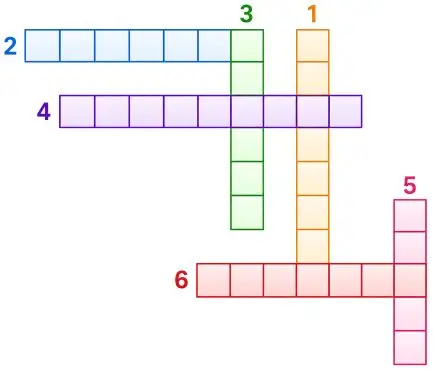
Across :
2. Motion of a second’s arm of a clock.
4. The movement of a guitar’s strings produces …………… motion.
6. …………… speed = total distance travelled/total time taken.
Down :
1. Motion of hands of a clock is …………… motion.
3. An object is said to be in ……………, if its position changes with time.
5. The distance covered by a body in unit time is called …………… of a body.
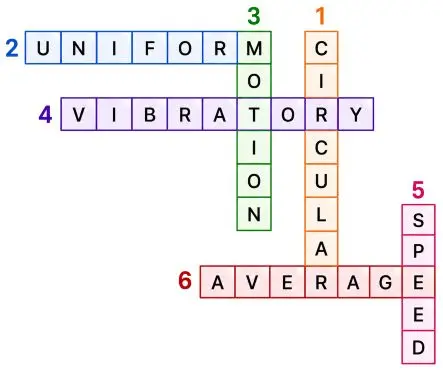
Answer:
The solved crossword puzzle is given below:
Think and Answer
A body has a mass of 100 kg on earth. What will be its mass on moon, considering gravity of moon is 1/6th of earth ? What will be its weight on earth and moon ?
Answer:
Mass does not change from place to place. Therefore, the mass of the body on the Moon will also be 100 kg.
Weight on Earth: W = mg = 100 × 9.8 = 980 N
Since the gravity on the Moon is 1/6th of the Earth, the weight on the Moon will be:
Weight on Moon \(=\frac{980}{6}\) ≈ 163.3 N
(E) Case Study
On the school sports ground, a student walks along a straight 200 m track. He covers every 20 m section in exactly the same time, from start to finish. On the same ground, a 400 m race was held late in the afternoon. During the race, another student starts very fast, then slows down in the middle, and finally sprints again near the finish line. The coach notes the times for both students.
Answer the following :
(i) Which student shows uniform motion? Explain.
(ii) If one student covers 100 m in 20 s, calculate his speed.
(iii) What kind of motion does the student who runs in the race show? Give a reason.
(iv) How is average speed different from speed at a particular moment?
Answer:
(i) The student walking along the 200 m track shows uniform motion because he covers equal distances in equal intervals of time.
(ii) Speed \(=\frac{\operatorname{Distance}}{Time}=\frac{100}{20}\) = 5 m/s
Therefore, the speed of the student is 5 m/s.
(iii) The student running in the race shows non-uniform motion because his speed changes during the race. He starts fast, slows down in the middle, and speeds up again near the finish line.
(iv) Average speed is the total distance travelled divided by the total time taken, whereas speed at a particular moment is the speed of an object at a specific instant of time.
ICSE Class 7 Physics Motion Selina Solutions PDF Download
Download ICSE Class 7 Physics Motion Selina Solutions PDF with chapter-wise solved answers, explanations, and free study resources for easy exam preparation.
Tips to Score Good Marks in Motion Chapter
- Learn all definitions carefully.
- Practice numerical problems regularly.
- Understand different types of motion with examples.
- Revise SI units and formulas.
- Solve previous years’ ICSE questions.
Conclusion
ICSE Class 7 Physics Chapter 2 Motion is a fundamental chapter that introduces students to the basic concepts of movement, speed, and types of motion. These Selina Solutions provide easy explanations and step-by-step answers that help students prepare confidently for school exams and competitive tests.
Regular practice of definitions, examples, and numericals will make the chapter simple and scoring for every student.
ICSE Class 7 Physics Selina Solutions
The Selina Concise Physics Class 7 book includes the following chapters:
| ☛ ICSE Class 7 Physics Chapter 1: Physical Quantities and Measurement Selina Solutions |
| ☛ ICSE Class 7 Physics Chapter 2: Motion Selina Solutions |
| ☛ ICSE Class 7 Physics Chapter 3: Energy Selina Solutions |
| ☛ ICSE Class 7 Physics Chapter 4: Light Energy Selina Solutions |
| ☛ ICSE Class 7 Physics Chapter 5: Heat Selina Solutions |
| ☛ ICSE Class 7 Physics Chapter 6: Sound Transfer Selina Solutions |
| ☛ ICSE Class 7 Physics Chapter 7: Electricity and Magnetism Selina Solutions |
Official Website:
Students can visit the official CISCE website for more details and updates.