Introduction
Motion is one of the most important topics in ICSE Class 7 Physics. Everything around us moves in one way or another — cars move on roads, fans rotate, the Earth revolves around the Sun, and even the hands of a clock are always in motion. Understanding motion helps students learn how objects change their position with time.
In this chapter, students learn about rest and motion, types of motion, speed, and distance. These concepts form the foundation for higher-level physics in later classes. To make learning easier, we have prepared simple and well-organized ICSE Class 7 Physics Motion Notes with examples and explanations.
Study Support by Rohit Academy
Rohit Academy offers expert-curated ICSE Class 7 Physics Study Materials including ICSE Motion Chapter Notes, diagrams, and key formulas for better understanding.
You can also visit:
| ☛ ICSE Class 7 Physics Chapter 2 : Motion Selina Solutions |
| ☛ ICSE Class 7 Physics |
| ☛ ICSE Class 7 Chemistry |
| ☛ ICSE Class 7 Mathematics |
| ☛ ICSE Class 7 Biology |
Motion Notes ICSE Class 7
Introduction to Motion
- Motion: An object is said to be in motion if its position changes with time with respect to its surroundings.
- Rest : If the position of an object does not change with time, the object is said to be at rest.
- Examples of Motion:
- Moving car
- Flying bird
- Running athlete
- Rotating fan
- Swinging pendulum
- Examples of Rest
- Book lying on a table
- Bench fixed under a tree
- Parked vehicle
Rest and Motion are Relative
Rest and motion are relative terms because an object may be at rest with respect to one object and in motion with respect to another object.
Example
- A passenger sitting inside a moving bus appears at rest to another passenger.
- Trees and buildings outside the bus appear to move backward.
Thus, an object may be at rest relative to one object and in motion relative to another.
Types of Motion
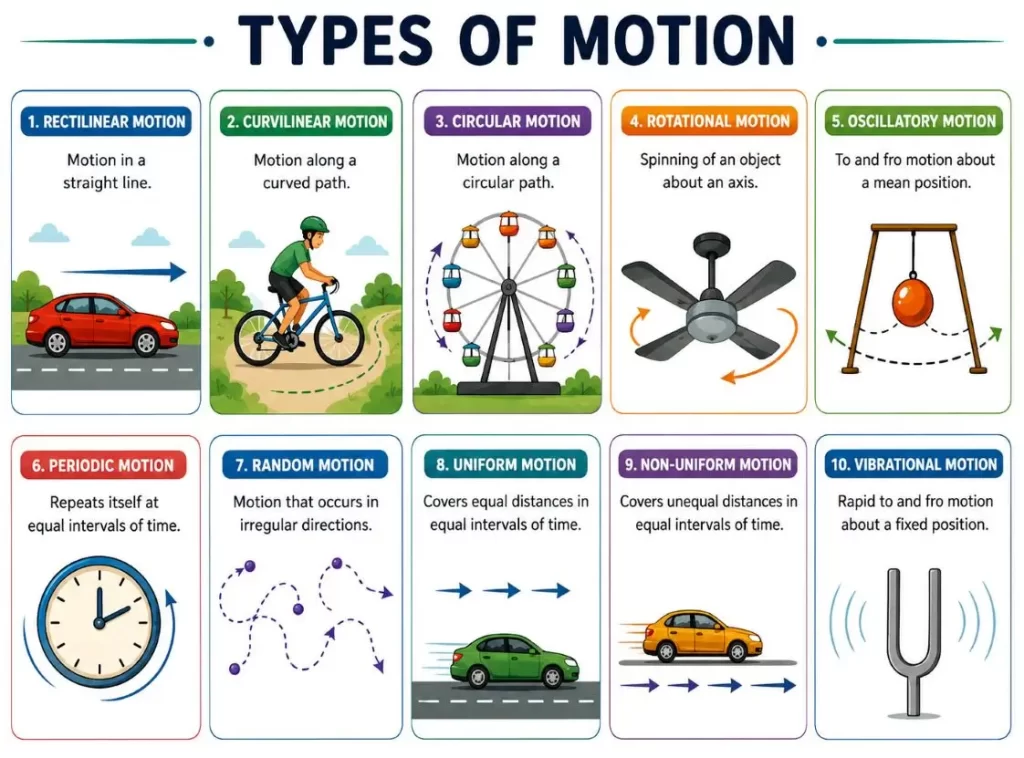
The five different types of motion are:
- Translatory motion
- Rotatory motion
- Circular motion
- Vibratory motion
- Oscillatory motion
1. Translatory Motion
When every point of a body moves through the same distance in the same interval of time, the motion is called translatory motion.
Examples
- Moving bicycle
- Walking man
- Falling apple
Types of Translatory Motion
(a) Rectilinear Motion
The motion of a body in a straight line is called rectilinear or linear motion.
Examples
- Car moving on a straight road
- Bullet fired from a gun
- Falling stone
(b) Curvilinear Motion
If the motion of a body is along a curved path, it is said to be a curvilinear motion.
Examples
- Ball thrown by a player
- Car moving on a curved road
- Cyclist taking a turn
2. Rotatory Motion
When a body rotates about a fixed axis, the motion is called rotatory motion.
Examples
- Ceiling fan
- Potter’s wheel
- Spinning top
- Earth rotating on its axis
Important Point
Different parts of the body move through different distances in the same time.
3. Circular Motion
Motion along a circular path is called circular motion.
Examples
- Hands of a clock
- Satellite revolving around Earth
- Stone tied to a string and whirled
Important Point
Distance from the centre remains constant.
Difference Between Rotatory and Circular Motion
| Rotatory Motion | Circular Motion |
| Body rotates about its own axis | Body moves around a fixed centre |
| Axis passes through the body | Axis lies outside the body |
| Example: Motion of Fan | Example: Motion of Satellite |
4. Oscillatory Motion
The to and fro motion of a body about its mean position is called oscillatory motion.
Examples
- Pendulum of a clock
- Swing
- Characteristics
- Motion repeats itself
- Has two extreme positions
5. Vibratory Motion
Vibratory motion is the motion in which a body moves to and fro about its mean position.
Examples
- Vibrating guitar string
- Vocal cords
- Tabla membrane
- Vibrating ruler
6. Periodic Motion
Motion that repeats itself after equal intervals of time.
Examples
- Earth revolving around the Sun
- Moon revolving around Earth
- Pendulum of a clock
- Needle of a sewing machine
7. Non-Periodic Motion
Motion that does not repeat itself after equal intervals of time.
Examples
- Footballer running on a field
- Ball rolling and stopping
- Motion of tides
Random Motion
Motion with no fixed path or direction.
Examples
- Molecules of gases
- Molecules of liquids
Mixed Motion
When a body has more than one type of motion simultaneously.
Examples
- Rolling wheel → translatory + rotatory
- Drill machine → translatory + rotatory
- Carpenter’s saw → translatory + oscillatory
- Earth → rotatory + circular + periodic
Speed
Speed is the distance travelled by a body in unit time.
Formula of Speed:
Speed \(=\frac{Distance\ \operatorname{travelled}}{Time\ taken}\)
SI Unit of Speed: metre per second (m/s)
Other Units
- kilometre per hour (km/h)
- centimetre per second (cm/s)
Uniform Motion
- If a body travels equal distances in equal intervals of time, the motion is called uniform motion.
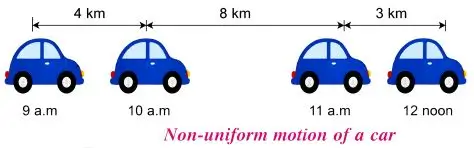
- Speed remains constant.
- Example: A train moving at constant speed.
Non-Uniform Motion
- If a body travels unequal distances in equal intervals of time, the motion is called non-uniform motion.
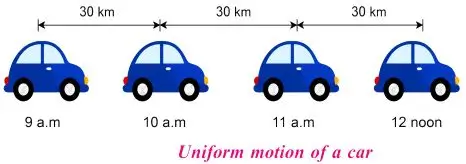
- Speed changes with time.
- Example: A car moving in city traffic.
Distinguish between uniform and non-uniform motions
| Uniform Motion | Non-uniform Motion |
| A body covers equal distances in equal intervals of time. | A body covers unequal distances in equal intervals of time. |
| Speed remains constant. | Speed changes with time. |
| Example: A train moving at constant speed. | Example: A car moving in city traffic. |
Average Speed
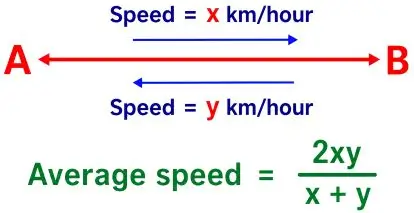
Average speed is the ratio of total distance travelled to total time taken.
Formula of Average Speed
Average Speed \(=\frac{Total\ Distance\ \operatorname{Travelled}}{Total\ Time\ Taken}\)
Mass
Mass is the quantity of matter contained in a body.
Characteristics of Mass
- Constant everywhere
- Does not change with place
- It can never be zero.
- Measured by beam balance
SI Unit of Mass: kilogram (kg)
Smaller Unit: gram (g)
Weight
Weight is the force with which the Earth attracts a body.
Formula of Weight: W = mg
Where:
- W = weight
- m = mass
- g = acceleration due to gravity
Characteristics of Weight
- Changes from place to place
- Depends on gravity
- It can be zero
- Weight is always directed vertically downwards.
- Measured by spring balance
SI Unit of weight: newton (N)
Another Unit: kilogram-force (kgf)
Relation: 1 kgf = 9.8 N
Difference Between Mass and Weight
Effect of Change in Place on Mass and Weight
- Mass remains same everywhere.
- Weight changes according to gravity.
Example
Weight on the Moon is about one-sixth of the weight on Earth.
Important Formulae
- Speed \(=\frac{Distance\ \operatorname{Travelled}}{Time\ Taken}\)
- Average Speed \(=\frac{Total\ Distance\ \operatorname{Travelled}}{Total\ Time\ Taken}\)
- Weight, W = mg
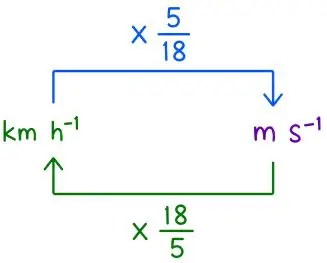
Relationship Between km h–1 and m s–1
1 km h–1 \(=\frac{5}{18}\) m s–1
Download ICSE Class 7 Physics Motion Notes PDF
Students searching for ICSE Class 7 Physics Motion Notes PDF Download can use these notes for free study support. Save the PDF and revise anytime on mobile or computer.
Conclusion
Motion is an essential concept in physics and daily life. By learning different types of motion, speed, and distance, students can better understand how objects move. These ICSE Class 7 Physics Motion Notes are useful for revision, homework, and exam preparation.
Students can also download the Motion Notes PDF for quick study and easy revision anytime.
ICSE Class 7 Physics Notes
| ☛ ICSE Class 7 Physics Chapter 1 – Physical Quantities and Measurement Notes |
| ☛ ICSE Class 7 Physics Chapter 2 – Motion Notes |
| ☛ ICSE Class 7 Physics Chapter 3 – Energy Notes |
| ☛ ICSE Class 7 Physics Chapter 4 – Light Energy Notes |
| ☛ ICSE Class 7 Physics Chapter 5 – Heat Notes |
| ☛ ICSE Class 7 Physics Chapter 6 – Sound Notes |
| ☛ ICSE Class 7 Physics Chapter 7 – Electricity and Magnetism Notes |
Official Website:
Students can visit the official CISCE website for more details and updates.