Introduction
Physics is a fascinating subject that helps us understand the world around us. One of the most important topics in ICSE Class 7 Physics is Physical Quantities and Measurement. This chapter introduces students to the basics of measurement, units, and physical quantities that are used in everyday life and scientific calculations.
If you are searching for ICSE Class 7 Physics Chapter 1 Physical Quantities and Measurement Selina Solutions, this article will help you understand the chapter in a simple and easy way. These solutions are useful for homework, revision, and exam preparation.
Study Support by Rohit Academy
Rohit Academy offers expert-curated ICSE Class 7 Physics Study Materials including ICSE Physical Quantities and Measurement Selina Solutions, diagrams, and key formulas for better understanding.
You can also visit:
| ☛ ICSE Class 7 Physics Chapter 1: Physical Quantities and Measurement Notes |
| ☛ ICSE Class 7 Physics |
| ☛ ICSE Class 7 Chemistry |
| ☛ ICSE Class 7 Mathematics |
| ☛ ICSE Class 7 Biology |
(A) Objective Type Questions
Question 1
Choose the correct answer from the multiple choices given below.
Question 1(a)
One litre is equal to:
(i) 1 cm3 (ii) 1 m3
(iii) 10–3 cm3 (iv) 10–3 m3
Answer:
(iv) 10–3 m3
Explanation:
1 litre = 1000 cm3 = 0.001 m3 = 10–3 m3.
Question 1(b)
A metallic piece displaces water of volume 15 mL. The volume of piece is:
(i) 15 cm3
(ii) 15 m3
(iii) 15 x 103 cm–3
(iv) 15 x 103 cm3
Answer:
(i) 15 cm3
Explanation:
1 mL = 1 cm3, so 15 mL = 15 cm3.
Volume of displaced water = volume of metallic piece.
Question 1(c)
A piece of paper of dimensions 1.5 m x 20 cm has area:
(i) 30 m2 (ii) 300 cm2
(iii) 0.3 m2 (iv) 3000 m3
Answer:
(iii) 0.3 m2
Explanation:
Convert 20 cm into metre:
20 cm = 0.2 m
Area = length × breadth
= 1.5 × 0.2 = 0.3 m2
Question 1(d)
The correct relation is:
(i) d = M x V (ii) M = d x V
(iii) V = d x M (iv) d = M + V
Answer:
(ii) M = d × V
Explanation:
Mass = Density × Volume
Question 1(e)
The density of alcohol is 0.8 g cm–3. In S.I. unit, it will be:
(i) 0.8 kg m–3 (ii) 0.0008 kg m–3
(iii) 800 kg m–3 (iv) 8 x 10³ kg m–3
Answer:
(iii) 800 kg m–3
Explanation:
1 g/cm3 = 1000 kg/m3
So,
0.8 g/cm3 = 0.8 × 1000 = 800 kg/m3
Question 1(f)
The density of aluminium is 2.7 g cm–3 and of brass is 8.4 g cm–3. For the same mass, the volume of:
(i) both will be same
(ii) aluminium will be less than that of brass
(iii) aluminium will be more than that of brass
(iv) nothing can be said.
Answer:
(iii) aluminium will be more than that of brass
Explanation:
Density of aluminium = 2.7 g/cm3
Density of brass = 8.4 g/cm3
For same mass:
Volume \(=\frac{\operatorname{Mass}}{Density}\)
Lower density means larger volume.
So aluminium has more volume.
Question 1(g)
A block of wood of density 0.8 g cm–3 has a volume of 60 cm3. The mass of block will be:
(i) 60.8 g (ii) 75 g
(iii) 48 g (iv) 0.013 g
Answer:
(iii) 48 g
Explanation:
Mass = Density × Volume
= 0.8 × 60 = 48 g
Question 1(h)
The correct relation for speed is:
(i) Speed = distance × time
(ii) Speed \(=\frac{\operatorname{Distance}}{Time}\)
(iii) Speed \(=\frac{\operatorname{Time}}{Distance}\)
(iv) Speed \(=\frac{1}{distance\ \times\ time}\)
Answer:
(ii) Speed \(=\frac{\operatorname{Distance}}{Time}\)
Explanation:
Speed tells how much distance is covered in unit time.
Question 1(i)
A boy travels a distance 150 m in 1 minute. His speed is:
(i) 150 m s–1
(ii) 2.5 m s–1
(iii) 25 m s–1
(iv) 9 m s–1
Answer:
(ii) 2.5 m s–1
Explanation:
1 minute = 60 seconds
Speed \(=\frac{\operatorname{Distance}}{Time}=\frac{150}{60}=\ 2.5\ m/s\)
Question 1(j)
The density of a substance …………… with the increase in the temperature.
(i) Increases
(ii) Decreases
(iii) remains same
(iv) none of the above
Answer:
(ii) decreases
Explanation:
On heating, most substances expand, volume increases, so density decreases.
Assertion Reason Type
Question 2(a)
Assertion (A): The density of water decreases when it is cooled from 4 °C to 0 °C.
Reason (R): Volume of water increases in cooling from 4 °C to 0 °C.
(i) Both A and R are true and R is the correct explanation of A
(ii) Both A and R are true and R is not the correct explanation of A
(iii) Assertion is false but reason is true
(iv) Assertion is true but reason is false
Answer:
(i) Both A and R are true and R is the correct explanation of A
Explanation:
Water has maximum density at 4°C.
When cooled from 4°C to 0°C, water expands (volume increases), so density decreases. Therefore both statements are true and Reason correctly explains Assertion.
Fill in the blanks
Question 3
Fill in the blanks:
(a) 1 m3 = …………… cm3.
(b) The volume of an irregular solid is determined by the method of …………… .
(c) Volume of a cube = …………… .
(d) The area of an irregular lamina is measured by using a …………… .
(e) Equal masses of different substances have different …………… .
(f) The S.I. unit of density is …………… .
(g) 1 g cm–3 = …………… kg m–3.
(h) 36 km h–1 = …………… m s–1.
(i) Speed of a vehicle at a particular instant is shown by …………… .
Answer:
(a) 1 m3 = 106 cm3.
(b) The volume of an irregular solid is determined by the method of displacement of liquid.
(c) Volume of a cube = (one side)3.
(d) The area of an irregular lamina is measured by using a graph paper.
(e) Equal masses of different substances have different volumes.
(f) The S.I. unit of density is kg m–3.
(g) 1 g cm–3 = 1000 kg m–3.
(h) 36 km h–1 = 10 m s–1.
(i) Speed of a vehicle at a particular instant is shown by speedometer.
True or False
Question 4
Write true or false for each statement:
(a) The S.I. unit of volume is litre.
(b) A measuring beaker of capacity 200 mL can measure only the volume of 200 mL of a liquid.
(c) cm2 is a smaller unit of area than m2.
(d) Equal volumes of two different substances have equal masses.
(e) The S.I. unit of density is g cm–3.
(f) 1 g cm–3 = 1000 kg m–3.
(g) The density of water is maximum at 4 °C.
(h) The speed 5 m s–1 is less than 25 km h–1.
(i) The S.I. unit of speed is m s–1.
Answer:
(a) False
Correct Statement : The S.I. unit of volume is cubic metre (m3).
(b) True
(c) True
(d) False
Correct Statement : Equal volumes of two different substances have different masses.
(e) False
Correct Statement : The S.I. unit of density is kg m–3.
(f) True
(g) True
(h) True
(i) True
Match the Columns
Question 5
Match the following:
| Column A | Column B |
| (a) Volume of a liquid | (i) kg m–3 |
| (b) Area of a leaf | (ii) m3 |
| (c) S.I. unit of volume | (iii) graph paper |
| (d) S.I. unit of density | (iv) m s–1 |
| (e) S.I. unit of speed | (v) measuring cylinder |
Answer:
| Column A | Column B |
| (a) Volume of a liquid | (v) measuring cylinder |
| (b) Area of a leaf | (iii) graph paper |
| (c) S.I. unit of volume | (ii) m3 |
| (d) S.I. unit of density | (i) kg m–3 |
| (e) S.I. unit of speed | (iv) m s–1 |
(B) Short Answer Type Questions
Question 1
Define the term volume of an object.
Answer:
The space occupied by an object is called its volume.
Question 2
State and define the S.I. unit of volume.
Answer:
The S.I. unit of volume is cubic metre (m3).
One cubic metre is the volume of a cube whose each side is 1 metre.
Question 3
State two smaller units of volume. How are they related to the S.I. unit?
Answer:
Two smaller units of volume are:
- cubic centimetre (cm3)
- cubic decimetre (dm3)
Relations:
- 1 m3 = 106 cm3
- 1 m3 = 103 dm3
Question 4
How will you determine the volume of a cuboid? Write the formula you will use.
Answer:
Measure its length, breadth, and height, then multiply them.
Formula:
Volume = Length × Breadth × Height
Question 5
You are required to take out 200 mL of milk from a bucket full of milk. How will you do it?
Answer:
Use a measuring jar or measuring cylinder of 200 mL capacity and fill it with milk from the bucket.
Question 6
Define the term density of a substance.
Answer:
Density of a substance is the mass per unit volume of that substance.
Question 7
State the S.I. and C.G.S. units of density. How are they related?
Answer:
- S.I. unit: kilogram per cubic metre (kg m–3)
- C.G.S. unit: gram per cubic centimetre (g cm–3)
Relation:
1 g cm–3 = 1000 kg m–3
Question 8
‘The density of brass is 8.4 g cm–3‘. What do you mean by the statement?
Answer:
It means that 1 cm3 of brass has a mass of 8.4 g.
Question 9
Arrange the following substances in order of their increasing density:
(a) iron
(b) cork
(c) brass
(d) water
(e) mercury.
Answer:
Cork < Water < Iron < Brass < Mercury
Question 10
How does the density of water change when:
(a) it is heated from 0 °C to 4 °C,
(b) it is heated from 4 °C to 10 °C?
Answer:
(a) Density increases.
(b) Density decreases.
Question 11
Write the density of water at 4 °C.
Answer:
The density of water at 4 °C is 1 g cm–3 or 1000 kg m–3.
Question 12
Explain the meaning of the term speed.
Answer:
Speed is the distance travelled by an object per unit time.
Question 13
Write the S.I. unit of speed.
Answer:
The S.I. unit of speed is metre per second (m s–1).
Question 14
A car travels with a speed 12 m s–1, while a scooter travels with a speed 36 km h–1. Which of the two travels faster?
Answer:
Given,
Speed of car = 12 m s–1
Speed of scooter = 36 km h–1
We know that:
1 km h–1 \(=\frac{5}{18}\) m s–1
So,
36 km h–1 \(=36\times\frac{5}{18}=\) 10 m s–1
Therefore, speed of scooter = 10 m s–1
Since,
Speed of scooter (10 m s–1) < Speed of car (12 m s–1)
So, the car travels faster than the scooter.
(C) Long Answer Type Questions
Question 1
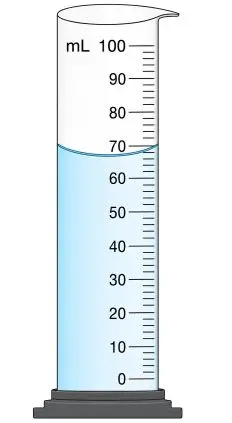
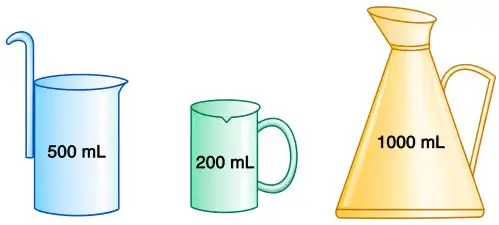
Name two devices which are used to measure the volume of an object. Draw their neat diagrams.
Answer:
The two devices which are used to measure the volume of an object are:
1. Measuring cylinder
2. Measuring beaker
Question 2
How can you determine the volume of an irregular solid (say a piece of brass)? Describe in steps with neat diagrams.
Answer:
Apparatus:
Measuring cylinder, water, thread, irregular solid (brass piece)
Procedure:
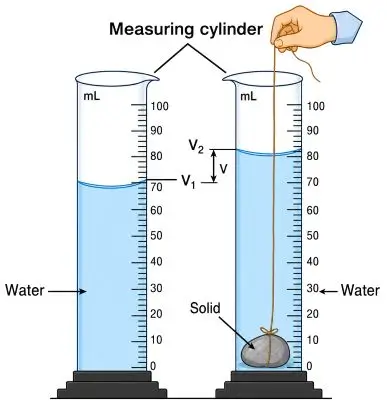
- Place a measuring cylinder on a flat horizontal surface.
- Pour some water into the cylinder.
- Note the initial water level as V1.
- Tie the brass piece with a thread and immerse it completely in water.
- Note the new water level as V2.
Calculation:
Volume of the solid = V2 – V1
Result:
The volume of the irregular solid is equal to the rise in the water level in the measuring cylinder.
Question 3
Describe the method in steps to find the area of an irregular lamina using a graph paper.
Answer:
Apparatus:
Graph paper, pencil, irregular lamina
Procedure:
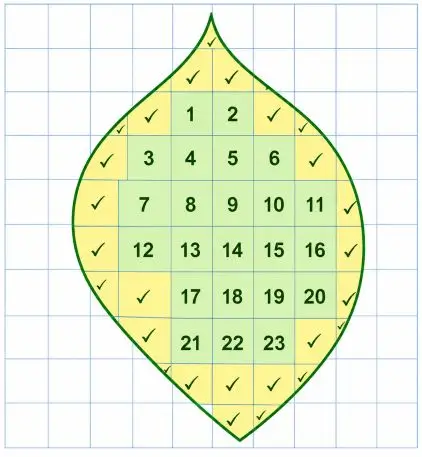
- Place the irregular lamina on a graph paper.
- Trace its outline carefully using a sharp pencil.
- Remove the lamina.
- Count the number of complete squares inside the traced figure.
- Count the incomplete (partial) squares separately.
- Approximate the area of partial squares (e.g., two half squares ≈ one full square).
- Add the total number of complete and equivalent squares.
Calculation:
Area of lamina = Total number of squares × Area of one square
Result:
The area of the irregular lamina is equal to the total number of squares counted multiplied by the area of one square.
(D) Numericals
Question 1
The length, breadth and height of a water tank are 5 m, 2.5 m and 1.25 m respectively. Calculate the capacity of the water tank in:
(a) m3
(b) litre
Solution:
Given:
Length = 5 m
Breadth = 2.5 m
Height = 1.25 m
(a) Capacity in m3:
Volume of tank = Length × Breadth × Height
= 5 × 2.5 × 1.25
= 15.625 m3
(b) Capacity in litres:
We know:
1 m3 = 1000 litres
So,
15.625 × 1000 = 15625 litres
Question 2
A solid silver piece is immersed in water contained in a measuring cylinder. The level of water rises from 50 mL to 62 mL. Find the volume of silver piece.
Solution:
Given,
Initial water level V1 = 50 mL
Final water level V2 = 62 mL
Volume of silver piece = V2 − V1
= 62 mL − 50 mL
= 12 mL
Since 1 mL = 1 cm3,
Volume of silver piece = 12 cm3
Therefore, the volume of the silver piece is 12 cm3.
Question 3
Find the volume of a liquid present in a dish of dimensions 10 cm x 10 cm x 5 cm.
Solution:
Given,
Length of dish = 10 cm
Breadth of dish = 10 cm
Height of liquid = 5 cm
Volume of liquid = Length × Breadth × Height
= 10 × 10 × 5
= 500 cm3
Therefore, the volume of the liquid is 500 cm3.
Question 4
A rectangular field is of length 60 m and breadth 35 m. Find the area of the field.
Solution:
Given,
Length of field = 60 m
Breadth of field = 35 m
Area of rectangular field = Length × Breadth
= 60 × 35
= 2100 m2
Therefore, the area of the field is 2100 m2.
Question 5
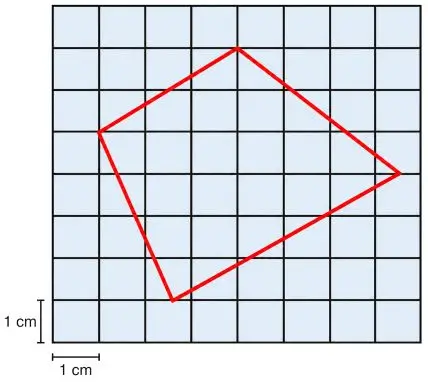
Find the approximate area of an irregular lamina of which boundary line is drawn on the graph paper shown in figure below.
Solution:
From the figure,
Number of complete squares = 11
Number of more than half squares = 8
Number of half squares = 2
So,
Total number of squares = 11 + 8 + 2 = 21
Since,
Area of one square = 1 cm × 1 cm = 1 cm2
Therefore,
Approximate area of the lamina = 21 × 1 = 21 cm2
So, the approximate area of the irregular lamina is 21 cm2.
Question 6
A piece of brass of volume 30 cm3 has a mass of 252 g. Find the density of brass in:
(i) g cm–3
(ii) kg m–3
Solution:
Given,
Volume of brass = 30 cm3
Mass of brass = 252 g
Density
(i) Density in g cm–3 :
Density 8.4 g cm–3
(ii) Density in kg m–3 :
We know,
1 g cm–3 = 1000 kg m–3
Therefore,
8.4 g cm–3 = 8.4 × 1000 = 8400 kg m–3
Question 7
The mass of an iron ball is 312 g. The density of iron is 7.8 g cm–3. Find the volume of the ball.
Solution:
Given,
Mass of iron ball = 312 g
Density of iron = 7.8 g cm–3
We know,
Density \(=\frac{\operatorname{Mass}}{Volume}\)
Therefore,
Volume \(=\frac{\operatorname{Mass}}{Volume}\ =\frac{312}{7.8}=\) 40 cm3
Therefore, the volume of the iron ball is 40 cm3.
Question 8
A cork has a volume 25 cm3. The density of cork is 0.25 g cm–3. Find the mass of the cork.
Solution:
Given,
Volume of cork = 25 cm3
Density of cork = 0.25 g cm–3
We know,
Density \(=\frac{\operatorname{Mass}}{Volume}\)
Therefore,
Mass = Density × Volume
= 0.25 × 25
= 6.25 g
Therefore, the mass of the cork is 6.25 g.
Question 9
The mass of 5 litre of water is 5 kg. Find the density of water in g cm–3.
Solution:
Given,
Mass of water = 5 kg
Volume of water = 5 litre
We know, 1 kg = 1000 g
∴ 5 kg = 5000 g
1 litre = 1000 cm3
∴ 5 litre = 5000 cm3
Density \(=\frac{\operatorname{Mass}}{Volume}\ =\ \frac{5000}{5000}\) 1 g cm–3
Therefore, the density of water is 1 g cm–3.
Question 10
A cubical tank of side 1 m is filled with 800 kg of a liquid. Find:
(i) the volume of tank,
(ii) the density of liquid in kg m–3.
Solution:
Given,
Side of cubical tank = 1 m
Mass of liquid = 800 kg
(i) Volume of tank:
Volume of cube = Side3
= 1 × 1 × 1
= 1 m3
(ii) Density of liquid:
Density \(=\frac{\operatorname{Mass}}{Volume}=\frac{800}{1}=\) 800 kg m–3
Question 11
A block of iron has dimensions 2 m x 0.5 m x 0.25 m. The density of iron is 7.8 g cm–3. Find the mass of block.
Solution:
Given,
Length of block = 2 m
Breadth of block = 0.5 m
Height of block = 0.25 m
Density of iron = 7.8 g cm–3
We know,
1 g cm⁻³ = 1000 kg m–3
∴ Density of iron = 7.8 × 1000 = 7800 kg m–3
Volume of block = Length × Breadth × Height
= 2 × 0.5 × 0.25
= 0.25 m3
Mass = Density × Volume
= 7800 × 0.25
= 1950 kg
Therefore, the mass of the iron block is 1950 kg.
Question 12
The mass of a lead piece is 115 g. When it is immersed into a measuring cylinder, the water level rises from 20 mL mark to 30 mL mark. Find:
(i) the volume of the lead piece,
(ii) the density of the lead in kg m–3.
Solution:
Given,
Mass of lead piece = 115 g
Initial water level = 20 mL
Final water level = 30 mL
(i) Volume of lead piece:
Volume = Final level − Initial level
= 30 mL − 20 mL
= 10 mL
Since 1 mL = 1 cm3,
Volume of lead piece = 10 cm3
(ii) Density of lead in kg m–3 :
Density \(=\frac{Mass}{Volume}=\frac{115}{10}=\) 11.5 g cm–3
We know,
1 g cm–3 = 1000 kg m–3
∴ 11.5 g cm–3 = 11.5 × 1000 = 11500 kg m–3
Question 13
The density of copper is 8.9 g cm–3. What will be its density in kg m–3?
Solution:
Given,
Density of copper = 8.9 g cm–3
We know,
1 g cm–3 = 1000 kg m–3
Therefore,
8.9 g cm–3 = 8.9 × 1000 = 8900 kg m–3
Therefore, the density of copper is 8900 kg m–3.
Question 14
A car travels a distance of 15 km in 20 minute. Find the speed of the car in:
(i) km h–1
(ii) m s–1
Solution:
Given,
Distance travelled = 15 km
Time taken = 20 minutes
(i) Speed in km h–1 :
We know,
20 minutes
Speed \(=\frac{Distance}{Time}\)
= 15 ÷ 1/3
= 15 × 3
= 45 km h–1
(ii) Speed in m s⁻¹ :
We know,
1 km h–1 = \(\frac{5}{18}\) m s–1
Therefore,
45 × \(\frac{5}{18}\) = 12.5 m s–1
Question 15
How long a train will take to travel a distance of 200 km with a speed of 60 km h–1?
Solution:
Given,
Distance = 200 km
Speed = 60 km h–1
Time \(=\frac{Distance}{Time}=\ \frac{200}{60}=\frac{10}{3}=3\frac{1}{3}h\)
Since,
1/3 hour = 20 minutes
Therefore,
Time taken = 3 hours 20 minutes.
Question 16
A boy travels with a speed of 10 m s–1 for 30 minute. How much distance does he travel?
Solution:
Given,
Speed of boy = 10 m s–1
Time = 30 minutes
We know,
30 minutes = 30 × 60 = 1800 s
Distance = Speed × Time
= 10 × 1800
= 18000 m
Therefore, the boy travels a distance of 18000 m.
Question 17
Express 36 km h–1 in m s–1.
Solution:
Given,
Speed = 36 km h–1
We know,
1 km h–1 = \(\frac{5}{18}\) m s–1
Therefore,
36 × \(\frac{5}{18}\) = 10 m s–1
Therefore, 36 km h–1 = 10 m s–1.
Question 18
Express 15 m s–1 in km h–1.
Solution:
Given,
Speed = 15 m s–1
We know,
1 m s–1 = \(\frac{18}{5}\) km h–1
Therefore,
15 × \(\frac{18}{5}\) = 54 km h–1
Therefore, 15 m s–1 = 54 km h–1.
Crossword Puzzle
Read the clues across and clues downwards and fill up the blank squares.
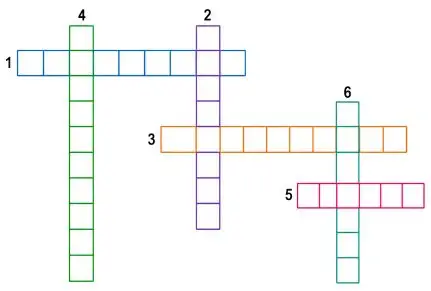
Across :
1. The device is used to measure the atmospheric pressure.
3. The area of a regular object can be found by measuring its
5. The S.I. unit of volume is …………… metre.
Down :
2. The …………… of a substance does not change with change in its shape or size.
4. The volume of …………… lamina is measured by using a graph paper.
6. The space occupied by an object
Answer:
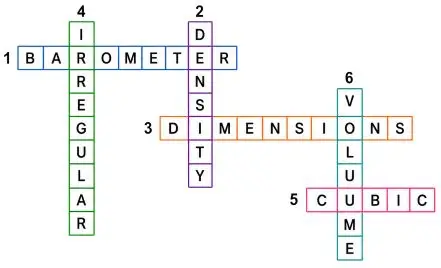
The solved crossword puzzle is given below:
Think and Answer
1 kg of salt occupies more space than 1 kg of copper. Give reason.
Answer:
1 kg of salt occupies more space than 1 kg of copper because the density of salt is less than that of copper. Therefore, for the same mass, salt occupies more volume, while copper, being denser, occupies less volume.
(E) Case Study
Question 1
Gunjan went with her father to a wood shop to buy blocks for a school project. The shopkeeper showed them several wooden cubes, each of size 5 cm x 5 cm x 5 cm. When Gunjan picked them up one by one, she noticed that some cubes felt lighter and some heavier even though they were exactly the same size. To check their weights, she placed two cubes on a digital weighing machine. One cube had a mass of 150 g and the other had a mass of 250 g. Her father smiled and told her that her careful observation was helping him choose the right material.
Answer the following :
(i) Since both blocks have the same dimensions but different masses, what can Gunjan conclude about their material ?
(ii) Calculate the density of the heavier block of mass 250 g.
(iii) Which property of matter explains why two objects of the same size can feel heavier or lighter?
(iv) If there is another block with the same density as the heavier block but double its volume, what happens to its mass?
Answer:
Given:
Dimensions of each cube = 5 cm × 5 cm × 5 cm
Volume of each cube = 5 × 5 × 5 = 125 cm³
Mass of heavier block = 250 g
(i) Since both blocks have the same dimensions but different masses, Gunjan can conclude that the blocks are made of different materials because different materials have different densities.
(ii) Density of the heavier block:
Density \(=\frac{Mass}{Volume}=\frac{250}{125}=\) 2 g/cm3
Therefore, the density of the heavier block is 2 g/cm3.
(iii) The property is density. It explains why objects of the same size can have different masses and feel heavier or lighter.
(iv) If another block has the same density but double the volume, then its mass will also become double.
New mass = 250 × 2 = 500 g
Therefore, the mass of the new block will be 500 g.
Download ICSE Class 7 Physics Chapter 1 Solutions PDF
Download ICSE Class 7 Physics Physical Quantities and Measurement Selina Solutions PDF with chapter-wise solved answers, explanations, and free study resources for easy exam preparation.
Why Students Need Selina Solutions?
The Selina Concise Physics textbook is widely used in ICSE schools. Students often need detailed solutions because some questions involve calculations and concepts that require proper explanation.
Benefits of Selina Solutions
Students prefer Selina Solutions because they provide:
- Step-by-step answers
- Easy explanations
- Accurate numerical solutions
- Better understanding of concepts
- Quick revision support
These solutions help students improve problem-solving skills and score better marks in exams.
Preparation Tips for Students
To score high marks in this chapter:
- Learn all definitions properly
- Practice unit conversions daily
- Solve Selina exercise questions regularly
- Revise SI units carefully
- Practice numerical problems
Regular revision will help students understand concepts clearly.
Conclusion
The chapter ICSE Class 7 Physics Chapter 1 Physical Quantities and Measurement Selina Solutions is very important because it builds the basic concepts of Physics. Students should understand measurements, SI units, and physical quantities thoroughly to perform well in exams.
ICSE Class 7 Physics Selina Solutions
The Selina Concise Physics Class 7 book includes the following chapters:
| ☛ ICSE Class 7 Physics Chapter 1: Physical Quantities and Measurement Selina Solutions |
| ☛ ICSE Class 7 Physics Chapter 2: Motion Selina Solutions |
| ☛ ICSE Class 7 Physics Chapter 3: Energy Selina Solutions |
| ☛ ICSE Class 7 Physics Chapter 4: Light Energy Selina Solutions |
| ☛ ICSE Class 7 Physics Chapter 5: Heat Selina Solutions |
| ☛ ICSE Class 7 Physics Chapter 6: Sound Transfer Selina Solutions |
| ☛ ICSE Class 7 Physics Chapter 7: Electricity and Magnetism Selina Solutions |
Official Website:
Students can visit the official CISCE website for more details and updates.