Current Electricity Class 10 Physics PYQs
ICSE Class 10 Physics Chapter 8 Current Electricity Previous Year Questions are an excellent resource for students preparing for the ICSE Class 10 Physics Board Examination. Practising previous year questions helps students understand the type of questions asked in the examination and identify important concepts from the chapter.
This collection of Current Electricity Class 10 ICSE PYQs covers important definitions, laws, formula-based questions, circuit problems, numerical problems and conceptual questions.
How to Prepare Current Electricity for the ICSE Board Exam
To prepare this chapter effectively:
- Learn all important definitions and laws.
- Memorise the important formulae.
- Practise series and parallel circuit problems.
- Solve numerical questions regularly.
- Revise EMF, internal resistance and terminal voltage.
- Practise previous year questions.
- Pay attention to units and mathematical steps.
- Revise important diagrams and circuit symbols.
Study Support by Rohit Academy
Rohit Academy offers expert-curated ICSE Class 10 Physics Study Materials including ICSE Current Electricity PYQs, diagrams, and key formulas for better understanding.
Study materials related to chapter 8: Current Electricity
To help you prepare the entire chapter thoroughly, explore the following study resources related to Chapter 8 Current Electricity:
ICSE Class 10 Physics Current Electricity: Previous Year Questions
Question 1
The V-I graph for a series combination and for a parallel combination of two resistors is as shown in the figure below: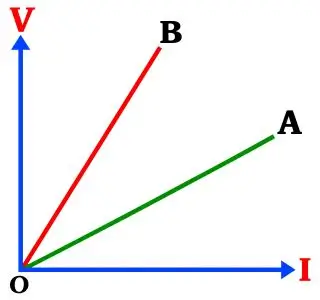
Which of the two, A or B, represents the parallel combination? Give a reason for your answer. [ICSE 2007]
Answer:
Line A represents the parallel combination.
Reason:
For the same change in current (I), the change in voltage (V) is less for line A than for line B. Therefore, line A is less steep, which means it has smaller resistance.
A parallel combination always has lower equivalent resistance than a series combination.
Hence, line A represents the parallel combination.
Question 2
Calculate the value of the resistance which must be connected to a 15 Ω resistance to provide an effective resistance of 6 Ω. [ICSE 2007]
Answer:
As the effective resistance is 6 Ω less than 15 Ω.
∴ Resistance R must be connected in parallel with 15 Ω.
Given,
- Reff = 6 Ω
- R1 = 15 Ω
- R2 = ?
Formula for resistors in parallel:
⇒
⇒
⇒
⇒
⇒
⇒
So, a 10 Ω resistor must be connected in parallel with the 15 Ω resistor to obtain an effective resistance of 6 Ω.
Question 3
A cell of e.m.f 1.5 V and internal resistance 10 Ω is connected to two resistors of 4.0 Ω and 20.0 Ω in series as shown in the figure: [ICSE 2007]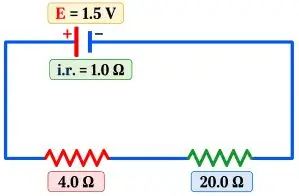
Calculate the:
(i) Current in the circuit.
(ii) Potential difference across the 4.0 Ω resistor.
(iii) Voltage drop when the current is flowing.
(iv) Potential difference across the cell.
Answer:
Given,
- EMF of cell = 1.5 V
- Internal resistance = 1 Ω
- External resistors in series = 4 Ω and 20 Ω
- Total external resistance, R = 4 + 20 = 24 Ω
- Total resistance of the circuit:
Rtotal = R + r = 24 + 1 = 25 Ω
(i) Current in the circuit:
⇒
⇒
Current = 0.06 A
(ii) Potential difference across the 4 Ω resistor:
⇒ V = I × R
⇒ V = 0.06 × 4 = 0.24 V
Potential difference across 4 Ω = 0.24 V
(iii) Voltage drop inside the cell (internal resistance):
⇒ V = I × r
⇒ V = 0.06 × 1 = 0.06 V
Voltage drop inside the cell = 0.06 V
(iv) Potential difference across the cell when current flows:
Terminal voltage = E – Ir
Terminal voltage = 1.5 − 0.06 = 1.44 V
Potential difference across the cell = 1.44 V
Question 4
(i) Sketch a graph to show the change in potential difference across the ends of an ohmic resistor and the current flowing in it. Label the axes of your graph.
(ii) What does the slope of the graph represent? [ICSE 2008]
Answer:
(i) Graph between potential difference (V) and current (I) for an ohmic resistor: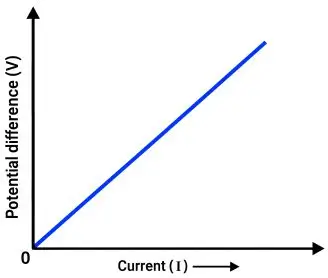
(ii) The slope of the V–I graph represents the resistance (R) of the resistor.
Question 5
An electrical heater is rated 4 kW, 220 V. Find the cost of using this heater for 12 hours if one kWh of electrical energy costs ₹ 3.25. [ICSE 2008]
Answer:
Given,
- Power of heater = 4 kW
- Voltage = 220 V
- Time = 12 hours
- Cost of 1 kWh = ₹ 3.25
Energy = Power × Time
Energy = 4 kW × 12 h = 48 kWh
Total Cost = Energy × Rate
Total Cost = 48 × 3.25 = ₹ 156
Question 6
How does the heat produced in a wire or a conductor depend upon the:-
(i) current passing through the conductor.
(ii) resistance of the conductor? [ICSE 2008]
Answer:
(i) Heat produced in a conductor is directly proportional to the square of current. (H α I2)
(ii) Heat produced in a conductor is directly proportional to the resistance of conductor. (H α R)
Question 7
Three resistors of 6.0 Ω, 2.0 Ω and 4.0 Ω respectively are joined together as shown in the figure.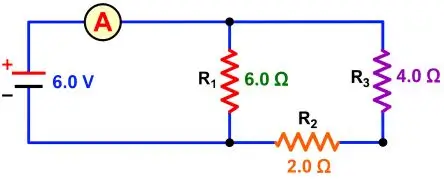
The resistors are connected to an ammeter and to a cell of emf 6.0 V.
Calculate:-
(i) The effective resistance of the circuit.
(ii) The current drawn from the cell. [ICSE 2008]
Answer:
(i) In the circuit, there are two parts.
First part:
Resistors of 2.0 Ω and 4.0 Ω are connected in series.
So, the equivalent resistance:
Rs = 2 + 4 = 6 Ω
Second part:
This Rs = 6 Ω is connected in parallel with another 6 Ω resistor.
Let the equivalent resistance be Rp.
Hence, the effective resistance of the entire circuit = 3 Ω.
(ii) Ammeter reading:
Given,
- R = 3 Ω
- V = 6.0 V
Using Ohm’s law:
⇒ V = IR
⇒ 6 = I × 3
⇒ I =
⇒ I = 2 A
Hence, the reading of the ammeter = 2 A.
Question 8
The equivalent resistance of the following circuit diagram is 4 Ω. Calculate the value of x. [ICSE 2009]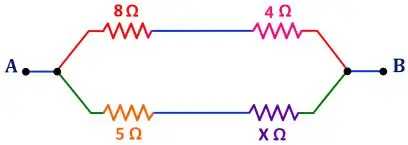
Answer:
Given,
Step 1: Series combinations
First series set:
Second series set:
Step 2: Parallel combination
Given that the equivalent resistance is:
R = 4 Ω
Using the parallel formula:
⇒
⇒
⇒
⇒
⇒
⇒
⇒
Hence, the value ofx = 1 Ω
Question 9
An electric heater is rated 1000 W – 200 V.
Calculate :
(i) the resistance of the heating element.
(ii) the current flowing through it. [ICSE 2009]
Answer:
Given,
- Power = 1000 W
- Voltage = 200 V
(i) Resistance of the heating element:
Using the formula:
⇒
⇒
⇒
⇒ R = 40 Ω
So, resistance = 40 Ω.
(ii) Current flowing through it:
P = V × I
⇒
⇒
⇒ I = 5 A
So, current = 5 A.
Question 10
(i) State Ohm’s Law.
(ii) Diagrammatically illustrate how you would connect a key, a battery, a voltmeter, an ammeter, an unknown resistance R and a rheostat so that it can be used to verify the above law. [ICSE 2009]
Answer:
Ohm’s Law: At constant temperature, the current flowing through a conductor is directly proportional to the potential difference (voltage) across its ends.
V ∝ I
Or, V = IR
Where,
- V = Potential difference
- I = Current
- R = Resistance of the conductor
Below circuit diagram shows the setup for verifying Ohm’s law: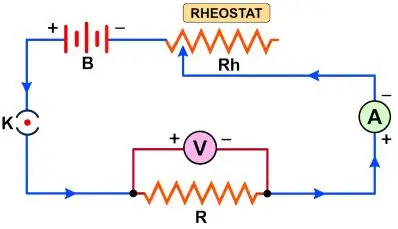
Question 11
Calculate the electrical energy consumed when a bulb of 40 W is used for 12.5 hours everyday for 30 days. [ICSE 2009]
Answer:
Given,
- Power of bulb, P = 40 W
- Time used per day = 12.5 hours
- Total days = 30 days
- Total time, t = 12.5 × 30 = 375 hours
Electrical energy consumed = Power × Time
⇒ E = 40 W × 375 h
⇒ E = 15000 Wh
⇒ E =
⇒ E = 15 kWh
Hence, the electrical energy consumed is 15 kWh.
Question 12
State a relation between electrical power, resistance and potential difference in an electrical circuit. [ICSE 2010]
Answer:
The relation between electrical power (P), resistance (R) and potential difference (V) is:
Question 13
Calculate the quantity of heat that will be produced in a coil of resistance 75 Ω if a current of 2A is passed through it for 2 minutes. [CSE 2010]
Answer:
Given,
- I = 2 A
- R = 75 Ω
- t = 2 minutes = 120 seconds
Heat energy produced in the coil,
H = I2 R t
⇒ H = (2)2 × 75 × 120
⇒ H = 4 × 75 × 120
⇒ H = 300 × 120
⇒ H = 36000 J
Question 14
Six resistances are connected together as shown in the figure. Calculate the equivalent resistance between the points A and B. [ICSE 2010]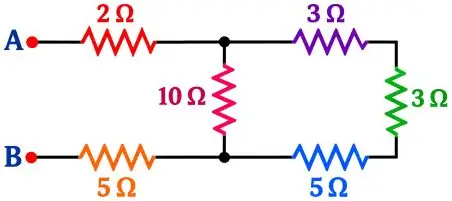
Answer:
Step 1 : Identify the Series Combination
Let R1 = 2 Ω, R2 = 3 Ω, and R3 = 5 Ω.
- Rseries = R1 + R2 + R3
- Rseries = 2 Ω + 3 Ω + 5 Ω
- Rseries = 10 Ω
Step 2: Identify the Parallel Combination
Let RA = Rseries = 10 Ω and RB = 10 Ω.
⇒
⇒
⇒
⇒
⇒ Rparallel = 5 Ω
Step 3: Calculate the Total Equivalent Resistance (RAB)
⇒ RAB = 2 Ω + Rparallel + 5 Ω
⇒ RAB = 2 Ω + 5 Ω + 5 Ω
⇒ RAB = 12 Ω
The equivalent resistance between the points A and B is 12 Ω.
Question 15
(i) A substance has nearly zero resistance at a temperature of 1 K. What is such a substance called?
(ii) State any two factors which affect the resistance of a metallic wire. [ICSE 2010]
Answer:
(i) A substance that has nearly zero resistance at very low temperatures (around 1 K) is called a superconductor.
(ii) Two factors that affect the resistance of a metallic wire are:
1. Length of the wire
2. Area of cross-section
Question 16
Five resistors of different resistances are connected together as shown in the figure. A 12 V battery is connected to the arrangement. 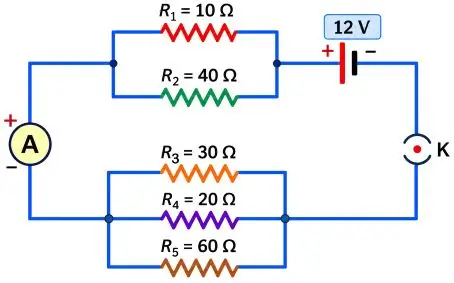
Calculate:-
(i) the total resistance in the circuit.
(ii) the total current flowing in the circuit. [ICSE 2010]
Answer:
Given,
- R1 = 10 Ω
- R2 = 40 Ω
(these two are in parallel) - R3 = 30 Ω
- R4 = 20 Ω
- R5 = 60 Ω
(these three are in parallel) - Battery voltage = 12 V
(i) From the given figure, R₁ and R₂ are parallel.
⇒
⇒
⇒
⇒
⇒
⇒
R3, R4 and R5 are also parallel.
⇒
⇒
⇒
⇒
⇒
⇒ Ω
Total resistance in the circuit: R = R′ + R″
R = 8 + 10
R = 18 Ω
(ii) V = 12 volt
Total current flowing in the circuit:
⇒
⇒
⇒
⇒
Question 17
Write an expression for calculating electrical power in terms of current and resistance. [ICSE 2011]
Answer:
The expression for electrical power in terms of current (I) and resistance (R) is P = I2R.
Question 18
Calculate the equivalent resistance between A and B from the following diagram: [ICSE 2011]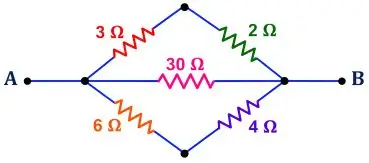
Answer:
3 Ω and 2 Ω form a series combination.
Therefore, r1 = 3 + 2 = 5 Ω
6 Ω and 4 Ω are also in series.
Their resultant resistance is:
r2 = 6 + 4 = 10 Ω
Now r₁, 30 Ω, and r₂ are connected in parallel.
So,
⇒ Rp = 3 Ω
Question 19
(i) Draw a graph of Potential difference (V) versus Current (I) for an ohmic resistor.
(ii) How can you find the resistance of the resistor from this graph ?
(iii) What is a non-ohmic resistor? [ICSE 2011]
Answer:
(i) Graph of V versus I for an Ohmic conductor:
(ii) We can find resistance by finding the slope of the graph.
(iii) The conductors which do not obey the Ohm’s law are known as the non-ohmic resistors.
Question 20
(i) An electric bulb is marked 100 W, 250 V. What information does this convey ?
(ii) How much current will the bulb draw if connected to a 250 V supply? [ICSE 2011]
Answer:
(i) When an electric bulb is rated ‘100 W, 250 V’, it means the bulb consumes 100 watts of power when it is operated at 250 volts.
(ii) Given,
- Power (P) = 100 W
- Voltage (V) = 250 V
We know that,
Power (P) = VI
⇒ 100 = 250 x I
⇒ I =
⇒ I = 0.4 A
Hence, current drawn = 0.4 A
Question 21
Three resistors are connected to a 12 V battery as shown in the figure given below: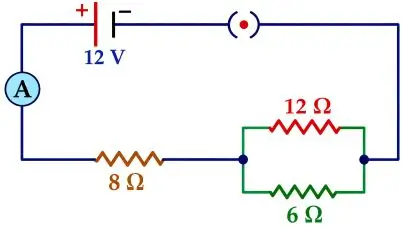
(i) What is the current through the 8 ohm resistor?
(ii) What is the potential difference across the parallel combination of 6 ohm and 12 ohm resistor ?
(iii) What is the current through the 6 ohm resistor? [ICSE 2011]
Answer:
Given,
- Battery voltage = 12 V
- Series resistor = 8 Ω
- Parallel resistors = 6 Ω and 12 Ω
(i) The 6 ohm and 12 ohm resistors are connected in parallel.
So,
⇒
⇒
⇒
⇒
⇒ R1 = 4 ohm
Total resistance of the circuit:
R = 8 ohm + 4 ohm = 12 ohm
Using Ohm’s law:
⇒ V = IR
⇒ 12 = I × 12
⇒ I = 1 A
(ii) Potential difference across the parallel combination:
V = IR = 1 × 4 = 4 V
(iii) Let I1 be the current through the 6 ohm resistor.
⇒ V = I1 × R
⇒ 4 = I1 × 6
⇒ I1 = = = 0.67 Amp.
Question 22
Two bulbs are marked 100 W, 220 V and 60 W, 110 V. Calculate the ratio of their resistances. [ICSE 2011]
Answer:
Given,
- Voltage of first bulb (V1) = 220 V
- Voltage of second bulb (V2) = 110 V
- Power of each bulb (P) = 60 W
We know that,
Case 1: For the 60 W, 220 V bulb
Case 2: For the 60 W, 110 V bulb
Now, the ratio of resistances is:
⇒
⇒ R1 : R2 = (2 × 110)2 : 1102
⇒ R1 : R2 = 22 : 12
⇒ R1 : R2 = 4 : 1
Hence, the ratio of the resistances of the two bulbs is 4 : 1.
Question 23
An electrical appliance is rated at 1000 KVA, 220V. If the appliance is operated for 2 hours, calculate the energy consumed by the appliance in : (i) kWh (ii) joule [ICSE 2012]
Answer:
Given,
- V = 220 V,
- Power rating = 1000 kVA
- Time = 2 hours
(i) Energy consumed in kWh:
Energy consumed,
E = P × t = 2000 kWh
(ii) Energy in joules:
We know,
1 kWh = 3.6 × 10⁶ J
So,
2000 kWh = 2000 × 3.6 × 106
= 7.2 × 10⁹ J
Question 24
Calculate the equivalent resistance between P and Q from the following diagram: [ICSE 2012]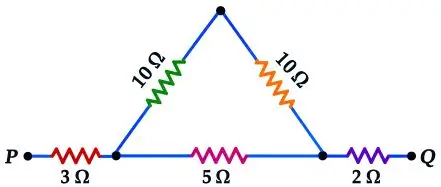
Answer:
Given,
r1 = 10 Ω, r2 = 10 Ω, r3 = 5 Ω
Step 1: Combine r1 and r2 in series
R1 = r1 + r2 = 10 + 10 = 20 Ω
Step 2: Combine R1 with r3 in parallel
⇒
⇒
⇒
⇒
⇒ Ω
Resistance between P and Q:
Given,
- r4 = 3 Ω
- r5 = 2 Ω
- Rp = 4 Ω
These three resistances are connected in series.
R = r4 + Rp + r5
R = 3 + 4 + 2 = 9 Ω
So, Resistance between P and Q = 9 Ω
Question 25
(i) A cell is sending current in an external circuit. How does the terminal voltage compare with the e.m.f. of the cell ?
(ii) What is the purpose of using a fuse in an electrical circuit?
(iii) What are the characteristic properties of fuse wire? [ICSE 2012]
Answer:
(i) When a cell supplies current, its terminal voltage becomes less than its e.m.f. due to the voltage drop across its internal resistance.
(ii) A fuse is used in an electrical circuit to protect the circuit and appliances from excessive current by melting and breaking the circuit when the current exceeds a safe limit.
(iii) Characteristics of fuse wire:
- It has a low melting point.
- It has high resistivity so that it heats up and melts quickly when excess current flows.
Question 26
(i) Write an expression for the electrical energy spent in the flow of current through an electrical appliance in terms of I, R and t.
(ii) At what voltage is the alternating current supplied to our houses ?
(iii) How should the electric lamps in a building be connected? [ICSE 2012]
Answer:
(i) The electrical energy spent is given by:
E = I2 R t
(ii) The alternating current supplied to our houses is 220 V in India.
(iii) The electric lamps in a building should be connected in parallel.
Question 27
Three resistors are connected to a 6V battery as shown in the figure given below: 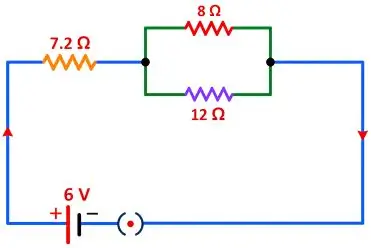
Calculate:
(i) the equivalent resistance of the circuit.
(ii) total current in the circuit.
(iii) potential difference across the 7.2 Ω resistor. [ICSE 2012]
Answer:
Given,
- Battery voltage = 6 V
- Resistors: 7.2 Ω, 8 Ω, 12 Ω
The 8 Ω and 12 Ω resistors are in parallel, and their combination is in series with 7.2 Ω.
(i)
⇒
⇒
⇒
⇒ Ω
⇒ Req = 7.2 + 4.8 = 12 ohm
(ii) Using Ohm’s law:
V = IR
⇒ 6 = I × 12
⇒ I = 0.5 A
(iii) Using Ohm’s law:
V = IR
⇒ V = 0.5 × 7.2
⇒ V = 3.6 V
Question 28
Calculate the equivalent resistance between the points A and B for the following combination of resistors: [ICSE 2013]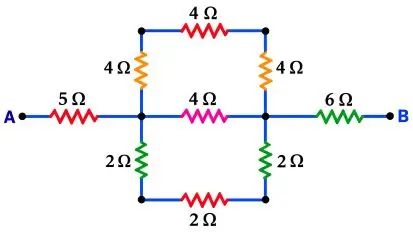
Answer:
In the circuit, there are four parts.
Part 1:
Three resistors of 4 Ω each are connected in series.
So, the equivalent resistance of this part is:
R’s = 4 + 4 + 4 = 12 Ω
Part 2:
Three resistors of 2 Ω each are connected in series.
So, the equivalent resistance of this part is:
R”s = 2 + 2 + 2 = 6 Ω
Part 3:
Now the three resistances 12 Ω (R’s), 4 Ω, and 6 Ω (R”s) are connected in parallel.
Let the equivalent resistance be Rp.
⇒
⇒
⇒
⇒
Part 4:
Finally, three resistances 5 Ω, Rp = 2 Ω, and 6 Ω are connected in series between points A and B.
So, the equivalent resistance = 5 + 2 + 6 = 13 Ω
Hence, the final equivalent resistance is 13 Ω.
Question 29
(i) State Ohm’s law.
(ii) A metal wire of resistance 6 Ω is stretched so that its length is increased to twice its original length. Calculate its new resistance. [ICSE 2013]
Answer:
(i) Ohm’s Law: At constant temperature, the current (I) through a conductor is directly proportional to the potential difference (V) across its ends.
𝑉 ∝ 𝐼
Or, V = IR
(ii) Given,
R1 = 6 Ω, R2 = ?
l1 = l, l2 = 2l
a1 = a, a2 = a/2
Since resistivity is same,
P1 = P2 (constant)
Using the formula:
constant
So,
⇒
⇒
⇒
⇒
⇒ R2 = 24 Ω
Question 30
The figure shows a circuit. When the circuit is switched on, the ammeter reads 0.5 A.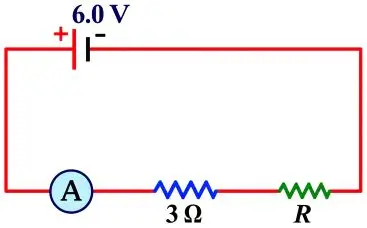
(i) Calculate the value of the unknown resistor R.
(ii) Calculate the charge passing through the 3Ω resistor in 120 s.
(iii) Calculate the power dissipated in the 3Ω resistor. [ICSE 2013]
Answer:
Given,
- Voltage of battery = 6.0 V
- Ammeter reading = 0.5 A
- Resistors in series: 3 ohm and R (unknown)
(i) Since resistors are in series:
Rtotal = = = 12 ohm
Total resistance is the sum:
Rtotal = 3 + R
⇒ 12 = 3 + R
⇒ R = 12 − 3 = 9 ohm
Value of the unknown resistor R = 9 ohm
(ii) Q = I × t
⇒ Q = 0.5 × 120
⇒ Q = 60 C
Charge = 60 coulombs
(iii) Power dissipated, P = I2 R
⇒ P = (0.5)2 × 3
⇒ P = 0.25 × 3
⇒ P = 0.75 W
Power dissipated = 0.75 W
Question 31
What is consumed using different electrical appliances, for which electricity bills are paid? [ICSE 2014]
Answer:
Electrical energy (measured in kWh) is consumed while using different electrical appliances.
Question 32
Find the equivalent resistance between points A and B. [ICSE 2014]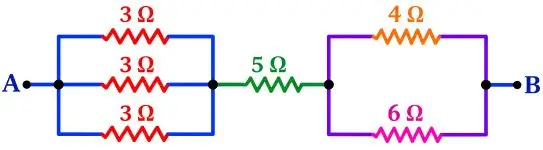
Answer:
Step 1: Equivalent of 3 Ω, 3 Ω and 3 Ω (parallel)
⇒
⇒
⇒
⇒
Step 2: Equivalent of 4 Ω and 6 Ω (parallel)
⇒
⇒
⇒
⇒
⇒ ohm
Step 3: Add all series resistances
⇒
⇒
⇒ Ω
Question 33
Two resistors of 4Ω and 6Ω are connected in parallel to a cell to draw 0.5 A current from the cell.
(i) Draw a labelled circuit diagram showing the above arrangement.
(ii) Calculate the current in each resistor. [ICSE 2014]
Answer:
(i) Labelled diagram of the arrangement is shown below: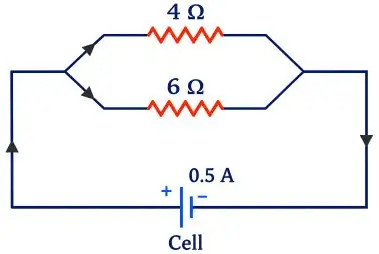
(ii) Two resistors of 4 Ω and 6 Ω are connected in parallel.
The equivalent resistance Rp is calculated as:
⇒
⇒
⇒
⇒
⇒ Ω
Question 34
(i) What is an Ohmic resistor?
(ii) Two copper wires are of the same length, but one is thicker than the other.
- Which wire will have more resistance?
- Which wire will have more specific resistance? [ICSE 2014]
Answer:
(i) Ohmic resistor: The conductors which obey the Ohm’s law are called the ohmic resistors or linear resistances. Examples are all metallic conductors (such as Silver, Aluminium, Copper, Iron etc.)
(ii) (1) The thinner wire will have more resistance.
(2) Both wires have the same specific resistance.
Question 35
(i) What happens to the resistivity of semi-conductors with the increase of temperature ?
(ii) For a fuse, higher the current rating .…….. is the fuse wire. [ICSE 2015]
Answer:
(i) The resistivity of semiconductors decreases with increase in temperature.
(ii) Thicker
Question 36
Find the equivalent resistance between points A and B. [ICSE 2015]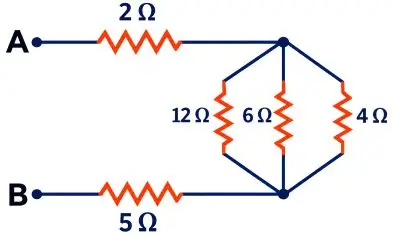
Answer:
Let be the equivalent resistance of the resistors 12 Ω, 6 Ω, and 4 Ω connected in parallel.
⇒
⇒
⇒
⇒
⇒
Now, the total resistance of the circuit is:
⇒ RAB = 2 Ω + Rp + 5 Ω
⇒ RAB = 2 Ω + 2 Ω + 5 Ω
⇒ RAB = 9 Ω
The equivalent resistance between points A and B is 9 Ω.
Question 37
The relationship between the potential difference and the current in a conductor is stated in the form of a law.
(i) Name the law.
(ii) What does the slope of V-I graph for a conductor represent ?
(iii) Name the material used for making the connecting wire. [ICSE 2015]
Answer:
(i) The relationship between the potential difference and the current in a conductor is given by Ohm’s law.
(ii) The slope of the V–I graph gives the resistance of the conductor.
(iii) The material used for making connecting wires is copper.
Question 38
A cell of Emf 2 V and internal resistance 1.2 Ω is connected with an ammeter of resistance 0.8 Ω and two resistors of 4.5 Ω and 9 Ω as shown in the diagram below: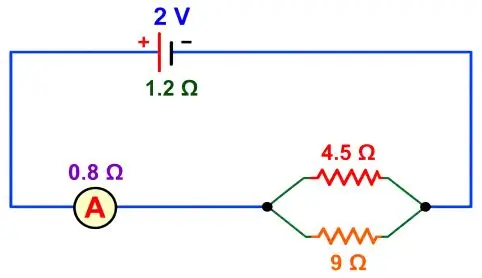
(i) What would be the reading on the Ammeter?
(ii) What is the potential difference across the terminals of the cell? [ICSE 2015]
Answer:
(i) To find the current (I):
Given,
e.m.f. = 2 V
First part: 4.5 Ω and 9 Ω in parallel
⇒
⇒
⇒
⇒
Second part: 1.2 Ω, 0.8 Ω and Rp = 3 Ω in series
Rs = 1.2 + 0.8 + 3 = 5 Ω
Using Ohm’s law,
⇒ V = IR
⇒ 2 = I × 5
⇒ I = 2/5
⇒ I = 0.4
A Hence, the reading of the ammeter = 0.4 A
(ii) Potential difference across the terminals of the cell:
ε = 2 V
⇒ I = 0.4 A
⇒ r = 1.2 Ω
⇒ V = ε – Ir
⇒ V = 2 – (0.4 × 1.2)
⇒ V = 2 – 0.48
⇒ V = 1.52 V
Hence, the p.d. across the cell = 1.52 V
Question 39
The V-I graph for a series combination and for a parallel combination of two resistors is shown in the figure below.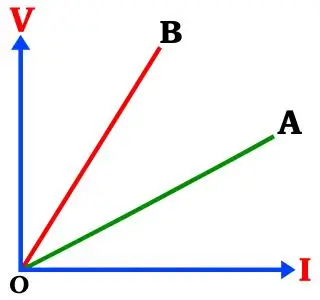
Which of the two A or B, represents the parallel combination? Give a reason for your answer. [ICSE 2016]
Answer:
Line A represents the parallel combination.
Reason:
For the same change in current (I), the change in voltage (V) is less for line A than for line B. Therefore, line A is less steep, which
means it has smaller resistance.
A parallel combination always has lower equivalent resistance than a series combination. Hence, line A represents the parallel combination.
Question 40
A music system draws a current of 400 mA when connected to a 12V battery.
(i) What is the resistance of the music system?
(ii) The music system is left playing for several hours and finally the battery voltage drops and the music system stops playing when the current drops to 320 mA. At what battery voltage does the music system stop playing? [ICSE 2016]
Answer:
(i) Given:
- I = 400 mA = 400 x 10–3 = 0.4 A
- V = 12 V
Using Ohm’s law:
V = IR
⇒ 12 = 0.4R
⇒ R = = 30 Ω
Hence, the resistance of the music system is 30 Ω.
(ii) Given,
- I = 320 mA = 320 x 10–3 A = 0.32 A
- R = 30 Ω
Again, using Ohm’s law:
V = IR = 0.32 x 30
⇒ V = 9.6 V
Hence, the battery voltage when the music system stops playing is 9.6 V.
Question 41
Calculate the quantity of heat produced in a 20 Ω resistor carrying 2.5 A current in 5 minutes. [ICSE 2016]
Answer:
Given,
- R = 20 Ω,
- I = 2.5 A,
- t = 5 min = 5 x 60 = 300 s
From relation, H = I2Rt
⇒ H = (2.5)2 x 20 x 300
⇒ H = 37500 J
Question 42
A battery of emf 12V and internal resistance 2Ω is connected with two resistors A and B of resistance 4Ω and 6Ω respectively joined in series.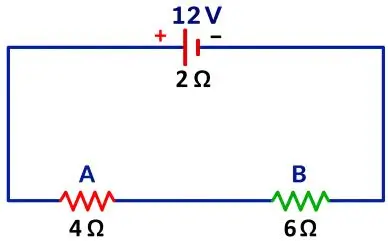
Find:-
(i) Current in the circuit.
(ii) The terminal voltage of the cell.
(iii) The potential difference across 6Ω Resistor.
(iv) Electrical energy spent per minute in 4Ω resistor. [ICSE 2016]
Answer:
Given,
- ε = 12 V
- Internal resistance, ri = 2 ohm
- RA = 4 ohm
- RB = 6 ohm
(i) Current in the circuit:
Total resistance = ri + RA + RB
= 2 + 4 + 6 = 12 ohm
1 A
(ii) Terminal voltage of the cell:
V = – I × ri
V = 12 – (1 × 2) = 10 V
(iii) Potential difference across the 6 ohm resistor:
VB = I × RB
VB = 1 × 6 = 6 V
(iv) Electrical energy spent in 60 seconds:
E = I2 × R × t
E = 12 × 4 × 60 = 240 J
Question 43
Define specific resistance and state its SI unit. [ICSE 2017]
Answer:
Specific resistance of a material is the resistance of a wire of that material of unit length and unit area of the cross section.
SI Unit: ohm-metre (Ω·m)
Question 44
An electric bulb of resistance 500 Ω, draws a current of 0.4 A. Calculate the power of the bulb and the potential difference at its end. [ICSE 2017]
Answer:
Given,
- Resistance = 500 ohms
- Current = 0.4 A
(i) Power of the bulb:
⇒ P = I × I × R
⇒ P = 0.4 × 0.4 × 500
⇒ P = 0.16 × 500 = 80 W
∴ Power = 80 W
(ii) Potential difference across the bulb:
V = I × R
V = 0.4 × 500 = 200 V
∴ Potential difference = 200 V
Question 45
You have three resistors of values 2 Ω , 3 Ω and 5 Ω How will you join them so that the total resistance is more than 7 Ω?
(i) Draw a diagram for the arrangement.
(ii) Calculate the equivalent resistance. [ICSE 2018]
Answer:
(i) 2 Ω ,3 Ω and 5 Ω have to be joined in series to obtain the total resistance more than 7 Ω.
(ii) The equivalent resistance R = R1 + R2 + R3
R = 2 + 3 + 5 = 10 Ω
Question 46
(i) A fuse is rated 8 A. Can it be used with an electrical appliance rated 5 kW, 200 V? Give a reason.
(ii) Name two safety devices which are connected to the live wire of a household electric circuit. [ICSE 2018]
Answer:
(i) Given,
- Power (P) = 5 kW = 5000 W
- Voltage (V) = 200 V
Current drawn,
25 A
Since the appliance draws 25 A when in use, an 8 A fuse cannot be used. The current is much higher than the fuse rating, so the fuse will blow and the circuit will break.
(ii) Two safety devices connected to the live wire are:
1. Fuse
2. MCB (Miniature Circuit Breaker)
Question 47
(i) Find the equivalent resistance between A and B.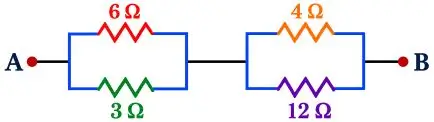
(ii) State whether the resistivity of a wire changes with the change in the thickness of the wire. [ICSE 2018]
Answer:
(i) 6 Ω and 3 Ω resistors are connected in parallel:
⇒
⇒
⇒
⇒
⇒ Ω
Similarly, 4 Ω and 12 Ω resistors are connected in parallel:
⇒
⇒
⇒
⇒
⇒ Ω
Now, R1 and R2 are connected in series.
Therefore, the equivalent resistance between A and B = (2 + 3) Ω = 5 Ω.
(ii) No, the resistivity of a wire does not change with the thickness of the wire.
Question 48
An electric iron is rated 220 V, 2 kW.
(i) If the iron is used for 2 h daily find the cost of running it for one week if it costs ₹ 4.25 per kWh.
(ii) Why is the fuse absolutely necessary in a power circuit? [ICSE 2018]
Answer:
(i) Given,
- Power (P) = 2 kW
- Voltage (V) = 220 V
- Time (t) = 7 × 2 = 14 h
From the relation,
⇒ E = P × t
⇒ E = 2 × 14 = 28 kWh
Cost for 1 kWh of energy = ₹ 4.25
∴ Cost for 28 kWh of energy
= 4.25 × 28 = ₹ 119
(ii) A fuse is absolutely necessary in a power circuit because it protects the appliances and the wiring from excessive current. If the current becomes too high, the fuse wire melts and breaks the circuit, preventing overheating, fire, or damage to electrical devices.
Question 49
How does an increase in the temperature affect the specific resistance of a:
(i) Metal and
(ii) Semiconductor? [ICSE 2019]
Answer:
(i) Metal: Its specific resistance increases with an increase in temperature.
(ii) Semiconductor: Its specific resistance decreases when the temperature increases.
Question 50
Calculate the effective resistance across AB. [ICSE 2019]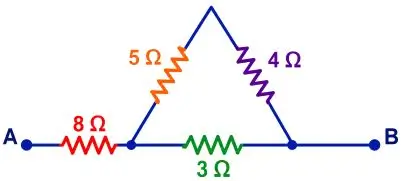
Answer:
In the first part, the 5 ohm and 4 ohm resistors are connected in series.
So, their equivalent resistance is:
5 + 4 = 9 ohms.
In the second part, this 9ohm resistor is in parallel with the 3 ohm resistor.
Let the equivalent resistance be Rp.
⇒
⇒
⇒
⇒
⇒ Ω
In the third part, the 8 ohm resistor and Rp (2.25 ohms) are in series.
So, the equivalent resistance between A and B is: 8 + 2.25 = 10.25 ohms
Hence, the total resistance between A and B is 10.25 ohms.
Question 51
The diagram shows a circuit with the key k open.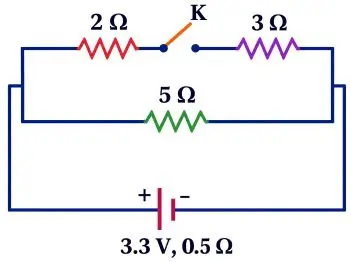
Calculate:
(i) the resistance of the circuit when the key k is open.
(ii) the current drawn from the cell when the key k is open,
(iii) the resistance of the circuit when the key k is closed.
(iv) the current drawn from the cell when the key k is closed. [ICSE 2019]
Answer:
(i) When key k is open, the resistances 5 Ω and 0.5 Ω are in series.
So, total resistance = 5 + 0.5 = 5.5 Ω
(ii) Using the formula:
⇒ 3.3 = I × 5.5
⇒ I =
⇒ I = 0.6 A
Hence, the current drawn from the cell when key k is open is 0.6 A.
(iii) When key k is closed, the 2 Ω and 3 Ω resistors are in series.
So, their total resistance = 2 + 3 = 5 Ω
This 5 Ω is in parallel with another 5 Ω resistor.
Therefore,
⇒
⇒
⇒
⇒ Ω
Now the total resistance of the circuit is:
2.5 + 0.5 = 3 Ω
(iv) Current drawn I =
I =
I = 1.1 A
Question 52
Why is it not advisable to use a piece of copper wire as fuse wire in an electric circuit? [ICSE 2020]
Answer:
Copper is not used as fuse wire because it has a high melting point and does not melt quickly during excess current.
Question 53
Calculate the total resistance across AB: [ICSE 2020]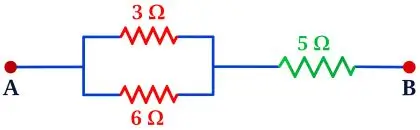
Answer:
The 3 Ω and 6 Ω resistors are connected in parallel.
⇒
⇒
⇒
⇒
⇒ Ω
The equivalent resistance Rp is in series with the 5 Ω resistor.
⇒ Rtotal = Rp + 5 Ω
⇒ Rtotal = 2 Ω + 5 Ω
⇒ Rtotal = 7 Ω
The total resistance across AB is 7 Ω.
Question 54
(i) What are superconductors?
(ii) Calculate the current drawn by an appliance rated 110 W, 220 V when connected across 220 V supply.
(iii) Name a substance whose resistance decreases with the increase in temperature. [ICSE 2020]
Answer:
(i) Superconductor: A superconductor is a substance of zero resistance (or infinite conductance) at a very low temperature.
Example: Mercury (below 4.2 K).
(i) Given,
● Power (P) = 110 W
● Voltage (V) = 220 V
We know that,
Power (P) = VI
⇒ 110 = 220 x I
⇒ I =
⇒ I = 0.5 A
Hence, current drawn = 0.5 A
(iii) A substance whose resistance decreases with an increase in temperature is a semiconductor.
Question 55
The diagram alongside shows three resistors connected across a cell of e.m.f. 1.8 V and internal resistance r.
Calculate:-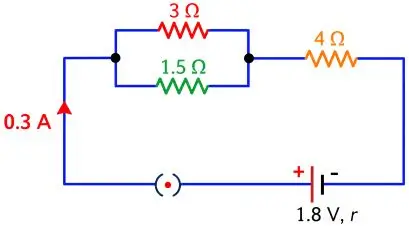
(i) Current through 3 Ω resistor.
(ii) The internal resistance r. [ICSE 2020]
Answer:
(i) The equivalent resistance of 3 Ω and 1.5 Ω connected in parallel is:
(since 1.5 Ω = 3/2 Ω)
⇒
Therefore, Rp = 1 Ω.
From the relation V = IR,
V = 0.3 × 1 = 0.3 V
So, the current through the 3 Ω resistor is:
(ii) Total resistance of the circuit = Rp + 4 + r
= (5 + r) Ω
Current in the circuit:
⇒ 0.3 = 1.8 / (5 + r)
⇒ 0.3 × (5 + r) = 1.8
⇒ (0.3 × 5) + (0.3 × r) = 1.8
⇒ 1.5 + 0.3r = 1.8
⇒ 0.3r = 1.8 − 1.5
⇒ 0.3r = 0.3
⇒ r = 1 Ω
Question 56
In the below circuit diagram, calculate: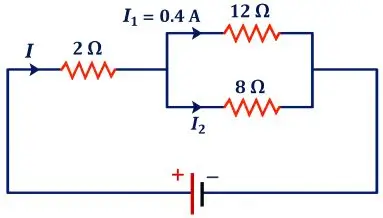
(a) the external resistance of the circuit.
(b) the current I2.
(c) the current I. [ICSE 2022 Sem 2]
Answer:
(a) The resistors 12 ohm and 8 ohm are connected in parallel.
⇒
⇒
⇒ ohm.
This equivalent resistance is in series with a 2 ohm resistor.
Total resistance = 2 + 4.8 = 6.8 ohm.
(b) Potential difference across parallel branches is the same.
So,
⇒ 12 × 0.4 = 8 × I
⇒ I2 = = 0.6 A.
(c) Total current: I = I1 + I2 = 0.4 + 0.6 = 1 A.
Question 57
An appliance rated 440 W, 220V is connected across 220V supply.
(a) Calculate the maximum current that the appliance can draw.
(b) Calculate the resistance of the appliance. [ICSE 2022 Sem 2]
Answer:
Given,
- Power rating, P = 440 W
- Voltage, V = 220 V
(a) Maximum current drawn:
P = VI
⇒ 440 = 220 × I
⇒
⇒ I = 2 A
∴ Maximum current drawn = 2 A
(b) Resistance of the appliance:
Using ohm’s law,
⇒ V = IR
⇒ 220 = 2 × R
⇒ R =
∴ R = 110 Ω
Question 58
If a wire of resistance 2Ω gets stretched to thrice its original length :
(a) Calculate the new resistance of the wire.
(b) What happens to the specific resistance of the wire? [ICSE 2022 Sem 2]
Answer:
(a) If:
- original length = L
- new length = 3L
Then the new area of cross-section becomes one-third (A/3).
New resistance, R’
⇒ R’
⇒ R’
⇒ R’
⇒ R’ = 18 Ω
∴ New resistance = 18 Ω
(ii) The specific resistance remains unchanged because specific resistance (resistivity ρ) of a material depends only on the material, not on its shape or size.
Question 59
Choose the correct option:-
When a current I flows through a wire of resistance R for time t then the electrical energy produced is given by: [ICSE 2023]
(a) I2Rt (b) IR2t
(c) IRt (d) IRt2
Answer:
(a) I2Rt
Explanation:
The electrical energy (heat energy) produced in a resistor when current flows through it is given by Joule’s Law of Heating:
H = I2 R t
Where:
- I = current
- R = resistance
- t = time
Question 60
Choose the correct option:-
Choose the correct relation for e.m.f. (e) and terminal voltage V: [ICSE 2023]
(a) ε = V (always)
(b) V > ε [always]
(c) V < ε [When the cell is in use]
(d) None of these
Answer:
(c) V < ε [When the cell is in use]
Explanation:
When a cell is used to send current to an external circuit, it’s terminal voltage V is less than it’s e.m.f.
Hence, terminal voltage < e.m.f.
Question 61
(a) Define specific resistance.
(b) What happens to the specific resistance of a conductor if its length is doubled?
(c) Name a substance whose specific resistance remains almost uncharged with the increase in its temperature. [ICSE 2023]
Answer:
(a) Specific resistance of a material is the resistance of a wire of that material of unit length and unit area of the cross section.
(b) The specific resistance remains unchanged because specific resistance (resistivity ρ) of a material depends only on the material, not on its shape or size.
(c) Manganin is a substance whose specific resistance remains almost unchanged by an increase in temperature.
Question 62
Find the value of current I drawn from the cell.
(a) Calculate the current I.
(b) Calculate the terminal voltage. [ICSE 2023]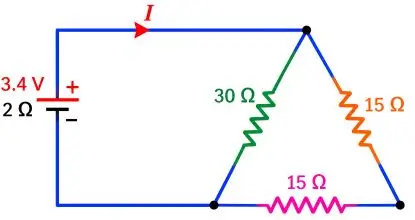
Answer:
Given,
● E.m.f. of cell, ε = 3.4 V
● Internal resistance = 2 Ω
(a) The two 15Ω resistors are in series.
So, Rs = 15 + 15 = 30 Ω
Now, this 30Ω is in parallel with another 30Ω resistor.
⇒
⇒
⇒
⇒
Total resistance of the circuit = 2Ω + 15Ω = 17Ω.
Current, I
I = = 0.2 A.
Therefore, current (I) = 0.2 A.
(b) Terminal voltage, V = ε – Ir
= 3.4 – [0.2 x 2]
= 3.4 – 0.4
= 3 V
Hence, terminal voltage = 3 V
Question 63
Choose the correct option:-
The specific resistance of a conductor depends on its: [ICSE 2024]
(a) length (b) material
(c) area of cross section (d) radius
Answer:
(b) material
Explanation:
The specific resistance (also called resistivity) of a conductor is a material property.
It does not depend on the dimensions of the conductor such as:
- Length
- area of cross-section
- radius
Question 64
Choose the correct option:-
The potential difference between terminals of a cell in a closed electric circuit is: [ICSE 2024]
(a) terminal voltage
(b) electro motive force
(c) voltage drop
(d) none of these
Answer:
(a) terminal voltage
Explanation:
In a closed electric circuit, current flows through the cell.
When current flows, some voltage is lost due to the internal resistance of the cell. So, the potential difference across the cell’s terminals in a closed circuit is the:
Terminal Voltage
It is given by:
V = ε – Ir
Where:
- V = terminal voltage
- ε = emf of the cell (open-circuit voltage)
- I = current flowing
- r = internal resistance
Question 65
A fuse is rated 5 A. Can it be used with a geyser rated 1540 W, 220 V. Write Yes or No. Give supporting calculations to justify your answer. [ICSE 2024]
Answer:
Given,
- voltage (V) = 220 V
- Power (P) = 1540 W
From formula:
P = IV
I = 7 A
The geyser needs 7 A, but the fuse is rated only 5 A.
Since 7 A > 5 A, the 5 A fuse will blow when the geyser operates.
No, a 5 A fuse cannot be used with a geyser rated 1540 W, 220 V.
Question 66
The voltage – current readings of a certain material are shown in the table given below:
| Voltage (V) | 10 V | 20 V | 30 V |
| Current (I) | 2 A | 3 A | 4 A |
Study the table.
(a) State whether the conductor used is ohmic or non-ohmic.
(b) Justify your answer.
(c) State Ohm’s law. [ICSE 2024]
Answer:
(a) The conductor is non-ohmic.
(b) Justification:
For an ohmic conductor, V/I must remain constant.
- At 10 V and 2 A, V/I = 5
- At 20 V and 3 A, V/I = 6.67
- At 30 V and 4 A, V/I = 7.5
Since the value of V/I is not constant, the conductor does not obey Ohm’s law. Hence, it is non-ohmic.
(c) Ohm’s law states that if physical conditions and the temperature of the conductor remain constant, the current flowing through the conductor is directly proportional to the potential difference across its ends.
Question 67
Study the diagram: 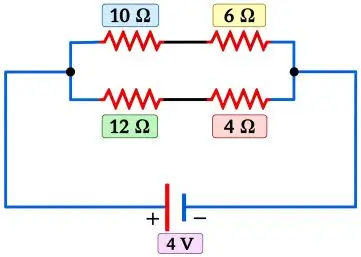
(a) Calculate the total resistance of the circuit.
(b) Calculate the current drawn from the cell.
(c) State whether the current through 10 Ω resistor is greater than, less than or equal to the current through the 12 Ω resistor. [ICSE 2024]
Answer:
Given,
V = 4 V
Let,
- R1 = 10 Ω
- R2 = 6 Ω
- R3 = 12 Ω
- R4 = 4 Ω
(a) Since R1 and R2 are in series,
RS = R1 + R2 = 10 + 6 = 16 Ω
Similarly, R3 and R4 are also in series,
R’s = R3 + R4 = 12 + 4 = 16 Ω
Now Rs and R’s are in parallel, so
⇒
⇒
⇒
⇒
⇒ 8 Ω
So, the total resistance of the circuit is 8 Ω.
(b) From Ohm’s law:
Current (I)
∴ Current drawn from the cell is 0.5 A.
(c) Current through the 10 Ω resistor:
Current through the 12 Ω resistor:
So, the current through 10 Ω resistor is equal to the current through the 12 Ω resistor.
Question 68
Choose the correct option:-
In a closed circuit containing a bulb and a cell, the electromotive force (ε) and the terminal voltage (V) is related as.
(Given I is current and r is internal resistance.) [ICSE 2025]
(a) V = ε + Ir (b) V = ε – Ir
(c) V = ε ÷ Ir (d) V = ε × Ir
Answer:
(b) V = ε – Ir
Explanation:
In a closed circuit, when current flows, some voltage is lost inside the cell due to its internal resistance (r).
Voltage drop inside cell = I r
Thus, the terminal voltage (V) = ε – Ir
Where:
- ε = electromotive force (emf)
- I = current
- r = internal resistance
Question 69
Choose the correct option:-
In the given circuits Y and Z, the resistors, R1 and R2, are connected in: [ICSE 2025]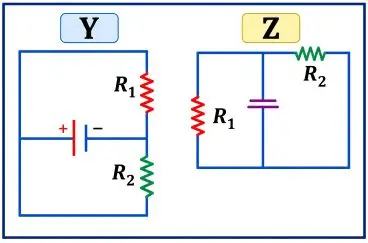
(a) series in both the circuits
(b) parallel in both the circuits
(c) parallel in Y and series in Z
(d) series in Y and parallel in Z
Answer:
(b) parallel in both the circuits
Question 70
Emf of a cell is __________ [greater than / less than / equal to] the terminal voltage when the cell is in open circuit. [ICSE 2025]
Answer:
Emf of a cell is equal to the terminal voltage when the cell is in open circuit.
Question 71
A current flows through a metallic conductor for a long period of time. State the change you would expect in its:
(a) Resistance
(b) Resistivity [ICSE 2025]
Answer:
(a) The resistance of a metal increases with temperature.
(b) Resistivity of metals increases with rise in temperature.
Question 72
Three identical bulbs B1, B2 and B3 each of power rating 18 W, 12 V are connected to a battery of 12 V.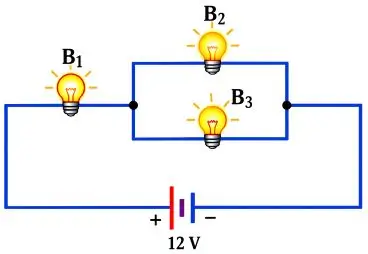
(a) Calculate:-
1. the resistance of each bulb
2. the current drawn from the cell
(b) If the bulb B3 is removed from the circuit, then will the brightness of the bulb B1 increase, decrease or remain the same? [ICSE 2025]
Answer:
Given,
- Battery emf (ε) = 12 V
- Voltage rating of each bulb (V) = 12 V
- Power rating of each bulb (P) = 18 W
(a)
- Resistance of each bulb:
Let the resistance of each bulb be R.
⇒ P
⇒ R
⇒ R
⇒ R
⇒ R Ω
∴ Resistance of each bulb = 8 Ω - Equivalent resistance of B2 and B3 (parallel)
⇒
⇒
⇒
⇒
Total circuit resistance:
B2 and B3 are in parallel, and this combination is in series with B₁.
RS = RP + R = 4 + 8 = 12 Ω
Current drawn from the battery, I =
I = = 1 A
∴ Current drawn from the battery = 1 A
(b) When B3 is removed:
The parallel branch breaks, so only B2 remains in series with B1.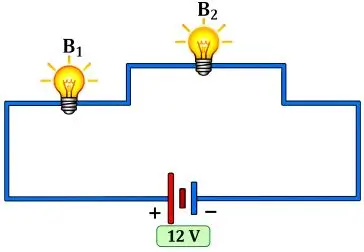
Thus, the new equivalent resistance:
Rnew = 8 + 8 = 16 Ω
Since resistance increases, current in the circuit decreases.
Hence, the brightness of B1 decreases.
Question 73
Choose the correct answer:-
In the circuit given below, identify the lamp (L1, L2, L3 and L4) whose failure would not interrupt the power supply to the other lamps. [ICSE 2026]
(A) L1 (B) L2
(C) L3 (D) L4
Answer:
(B) L2
Explanation:
L2 is connected in a separate parallel branch. If L2 fails, the circuit through L1, L3 and L4 remains complete, so their power supply is not interrupted.
Therefore, L2 is the correct answer.
Question 74
Choose the correct answer:-
The correct formula to calculate the equivalent resistance of two resistors R1 and R2 when connected in parallel, is: [ICSE 2026]
(A)
(B)
(C)
(D)
Answer:
(B)
Explanation:
For two resistors connected in parallel,
Therefore,
Hence, option (B) is correct.
Question 75
A resistance R is connected across a cell with a switch and a rheostat in series. A voltmeter is connected parallel across the cell. Current in the circuit is increased using the rheostat.
(a) How will the voltmeter reading change? (increase / decrease / remain the same)
(b) Justify your answer stated in (a) above. [ICSE 2026]
Answer:
(a) The voltmeter reading decreases.
(b) The voltmeter measures the terminal voltage of the cell, which is given by:
V = ε – Ir
Where,
- ε is the emf of the cell,
- I is the current flowing through the circuit,
- r is the internal resistance of the cell.
When the rheostat is adjusted to increase the current, the potential drop across the internal resistance (Ir) increases. Therefore, the terminal voltage of the cell decreases.
Hence, the voltmeter reading decreases.
Question 76
Bulb A rated 160 W, 40 V and Bulb B rated 40 W, 40 V are connected as shown in the diagram.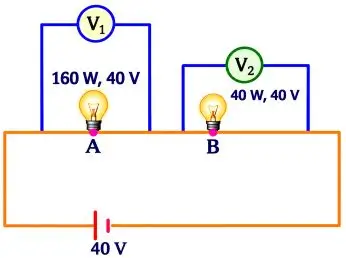
(a) Calculate the ratio V1 : V2.
(b) If the bulb A fuses, the current in the circuit remains the same. State True or False. [ICSE 2026]
Answer:
Given,
- Power rating of bulb A (PA) = 160 W
- Voltage rating of bulb A (VA) = 40 V
- Power rating of bulb B (PB) = 40 W
- Voltage rating of bulb B (VB) = 40 V
- Supply voltage (V) = 40 V
(a) Resistance of bulb A is given by:
Similarly, resistance of bulb B is:
According to Ohm’s law:
V = IR
Since the bulbs are connected in series, the same current flows through both bulbs. Therefore, the potential difference across the bulbs is divided in the ratio of their resistances.
V1 : V2 = RA : RB
= 10 : 40
= 1 : 4
Hence, V1 : V2 = 1 : 4.
(b) False.
If bulb A fuses, the circuit becomes open and no current can flow through the circuit. Therefore, the current becomes zero and does not remain the same.
Question 77
In the combinations of resistors shown below. calculate: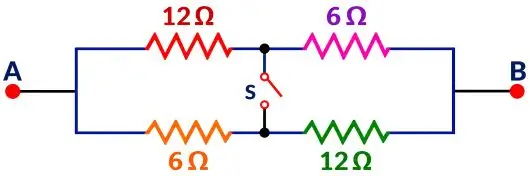
(a) the resistance across AB when the switch S is open.
(b) the resistance across AB when the switch S is closed. [ICSE 2026]
Answer:
Given resistors: 12 Ω and 6 Ω in each branch.
(a) When switch S is open:
Upper branch resistance:
R1 = 12 + 6 = 18 Ω
Lower branch resistance:
R2 = 6 + 12 = 18 Ω
These two branches are in parallel:
⇒
⇒
⇒
Hence, the resistance across AB when switch S is open is 9 Ω.
(b) When switch S is closed:
The 12 Ω and 6 Ω resistors on the left are in parallel:
Similarly, on the right:
These two combinations are in series:
R = 4 + 4 = 8 Ω
Hence, the resistance across AB when switch S is closed is 8 Ω.
Question 78
An electric iron rated 1100 W, 220 V is operated for 5 hours.
Calculate:-
(a) the minimum rating of the fuse required.
(b) the energy consumed in kWh.
(c) the cost of the energy consumed, if the rate is ₹ 10 per unit. [ICSE 2026]
Answer:
Given,
- Power of electric iron, P = 1100 W
- Voltage, V = 220 V
- Time, t = 5 h
- Cost of electricity = ₹10 per unit
(a) Current drawn by the iron:
I =
⇒ I =
⇒ I = 5 A
Therefore, the fuse rating should be slightly higher than 5 A.
Hence, the minimum rating of the fuse required is 6 A.
(b) Energy consumed:
Energy = Power × Tim
= 1.1 kW × 5 h
= 5.5 kWh
Hence, the energy consumed by the iron is 5.5 kWh.
(c) Cost of energy consumed:
Cost = Energy consumed × Cost per unit
= 5.5 × ₹10
= ₹ 55
Hence, the cost of the energy consumed is ₹ 55.
Download Current Electricity Previous Year Questions PDF
Students can download and practise the ICSE Class 10 Physics Chapter 8 Current Electricity Previous Year Questions PDF for revision and examination preparation.
For more ICSE Class 10 Physics Notes, Important Questions, Previous Year Questions and PDF study materials, visit Rohit Academy.
Why Practice Previous Year Questions?
Practising ICSE Class 10 Physics Current Electricity Previous Year Questions helps students become familiar with commonly tested concepts and the style of board-examination questions. It also provides useful practice in applying formulae and solving numerical problems within the examination.
Current Electricity PYQs with Answers
Students can use this question collection along with their ICSE Class 10 Physics Current Electricity Notes to revise the chapter. Practising questions first and checking the answers afterwards can help identify areas that require further revision.
Conclusion
Current Electricity is an important chapter for ICSE Class 10 Physics preparation. Students should focus on concepts, formulae, circuit-based questions and numerical problems. Regular practice of previous year questions can help students improve their problem-solving skills and prepare systematically for the board examination.
You can also visit:
ICSE Class 10 Physics Important Previous Year Questions
| ☛ Chapter 1 – Force Previous Year Questions |
| ☛ Chapter 2 – Work, Energy and Power Previous Year Questions |
| ☛ Chapter 3 – Machines Previous Year Questions |
| ☛ Chapter 4 – Refraction of Light at Plane Surfaces Previous Year Questions |
| ☛ Chapter 5 – Refraction through Lens Previous Year Questions |
| ☛ Chapter 6 – Spectrum Previous Year Questions |
| ☛ Chapter 7 – Sound Previous Year Questions |
| ☛ Chapter 8 – Current Electricity Previous Year Questions |
| ☛ Chapter 9 – Electrical Power and Household Circuits Previous Year Questions |
| ☛ Chapter 10 – Electro-magnetism Previous Year Questions |
| ☛ Chapter 11 – Calorimetry Previous Year Questions |
| ☛ Chapter 12 – Radioactivity Previous Year Questions |
Official Websites