Introduction
Physics is one of the most interesting subjects in school because it helps us understand how the world works. In ICSE Class 7 Physics, the chapter Physical Quantities and Measurement forms the foundation of scientific learning. Students learn about units, measurements, instruments, and the importance of accuracy in science.
If you are searching for ICSE Class 7 Physics Physical Quantities and Measurement Notes PDF Download, you are in the right place. These notes are designed to help students understand concepts easily and prepare effectively for exams.
Study Support by Rohit Academy
Rohit Academy offers expert-curated ICSE Class 7 Physics Study Materials including ICSE Physical Quantities and Measurement Chapter Notes, diagrams, and key formulas for better understanding.
You can also visit:
| ☛ ICSE Class 7 Physics Chapter 1 : Physical Quantities and Measurement Selina Solutions |
| ☛ ICSE Class 7 Physics |
| ☛ ICSE Class 7 Chemistry |
| ☛ ICSE Class 7 Mathematics |
| ☛ ICSE Class 7 Biology |
Physical Quantities and Measurement Notes ICSE Class 7
Introduction
Measurement is the process of comparing an unknown quantity with a fixed known quantity of the same kind called a unit.
Basic Physical Quantities
1. Length
- Length is the distance between two points.
- S.I. Unit: metre (m)
- Measuring Instruments: metre scale, ruler, measuring tape
- Examples:
- Length of a pencil
- Height of a student
- Distance between two places
2. Mass
- Mass is the quantity of matter present in a body.
- S.I. Unit: kilogram (kg)
- Measuring Instruments: beam balance, electronic balance
- Examples
- Mass of fruits
- Mass of school bag
3. Time
- Time is the interval between two events.
- S.I. Unit: second (s)
- Measuring Instruments: clock, stopwatch
- Examples
- Time taken to complete a race
- Duration of a class
4. Temperature
- Temperature measures the hotness or coldness of a body.
- S.I. Unit: kelvin (K)
- Other common units: degree Celsius (°C), degree Fahrenheit (°F)
- Measuring Instrument: thermometer
Measurement of Volume
The space occupied by an object is called its volume.
❖ SI Unit of Volume
The SI unit of volume is cubic metre (m³).
❖ Cubic Metre
One cubic metre is the volume of a cube whose each side is 1 metre.
1 m3 = 1 m × 1 m × 1 m
❖ Smaller Unit of Volume
- cubic centimetre (cm3)
- cubic decimetre (dm3)
❖ Relations:
- 1 m3 = 106 cm3
- 1 m3 = 103 dm3
Units of Liquid Volume
| Unit | Relation |
| 1 litre (L) | 1000 cm3 |
| 1 millilitre (mL) | 1 cm3 |
| 1 litre | 1000 mL |
Important Conversions
- 1 m3 = 1000 L
- 1 L = 1000 cm3
- 1 mL = 1 cm3
Measuring the Volume of Liquids
(1) Measuring Cylinder:
A measuring cylinder is used to measure the volume of liquids accurately.
Steps to Measure Volume Using a Measuring Cylinder
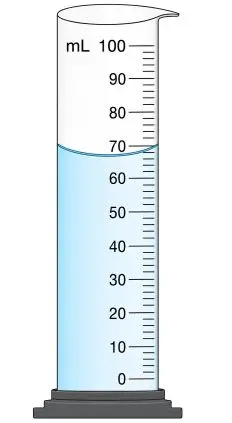
- Place the measuring cylinder on a flat surface
- Pour the liquid gently.
- Wait till the liquid becomes stationary.
- Read the lower meniscus at eye level.
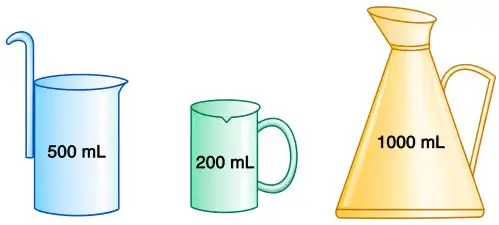
(2) Measuring Beaker
A measuring beaker is used to measure larger quantities of liquids such as milk, oil and water. (e.g., 50 mL, 200 mL, 1 L).
Measurement of Volume of Regular Solids
The volume of regular objects is found using mathematical formulas.
- Volume of a Cube, V = (side)3
- Volume of a Cuboid, V = length × breadth × height
- Volume of a Sphere, V = \(\frac{4}{3}\) × π × r3
- Volume of a Cylinder, V = πr2h
- Volume of a Cone, V = \(\frac{1}{3}\) × πr2h
Where:
- r = radius
- h = height
- π = 3.14 or 22/7
Measurement of Volume of an Irregular Solid
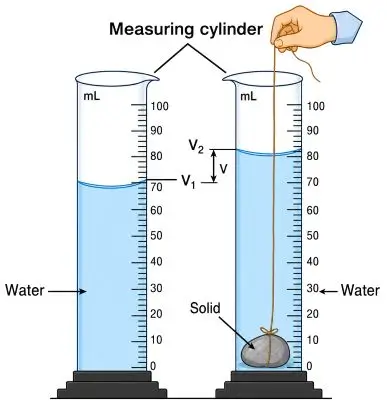
The volume of an irregular solid is determined by the method of displacement of liquid.
Procedure:
- Fill a measuring cylinder partly with water.
- Note the initial water level V1.
- Immerse the object completely in water.
- Note the final water level V2.
- Volume of the object = V2 – V1.
Important Relation:
- 1 mL = 1 cm3
- 1m3 = 1000 L
Measurement of Area
The surface occupied by an object is called its area.
❖ SI Unit of Area
The SI unit of area is square metre (m²).
❖ Other Units of Area
- 1 are = 100 m2
- 1 hectare = 10,000 m2
- 1 km2 = 1,000,000 m2
- 1 cm2 = 10–4 m2
- 1 mm2 = 10–6 m2
- 1m2 = 10000 cm2
Measurement of Area of Regular Objects
- Area of a Square = (side)2
- Area of a Rectangle = length × breadth
- Area of a Circle = πr2
- Curved Surface Area of a Cylinder = 2πrh
- Surface Area of a Sphere = 4πr2
Measurement of Area of an Irregular Object
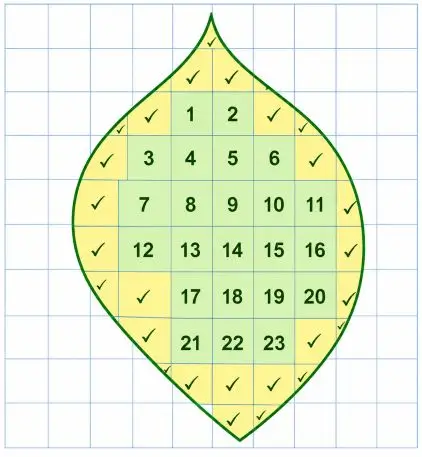
The area of an irregular object is estimated using a graph paper.
Procedure
- Place the object on graph paper.
- Trace its boundary.
- Count complete squares.
- Count squares more than half.
- Ignore squares less than half.
- Add the counted squares.
Approximate Area = Total counted squares × Area of one square
Density
Different substances of equal volume have different masses. This property is called density.
Definition of Density
Density is the mass of unit volume of a substance.
Formula:
\(Density=\frac{\operatorname{Mass}}{Volume}\)
\(d=\frac{\operatorname{M}}{V}\)
Where:
- d = density
- M = mass
- V = volume
Meaning of Density
- A substance with high density has particles packed closely together.
- A substance with low density has particles loosely packed.
- A substance with high density has more mass in a smaller space (e.g., lead), whereas low density means less mass in a large space (e.g., foam).
- Examples:
- Equal Mass but Different Volume
1 kg cotton occupies more space than 1 kg iron.
Reason: Cotton is less dense. - Equal Volume but Different Mass
1 cm3 iron has more mass than 1 cm3 wood.
Reason: Iron is denser.
- Equal Mass but Different Volume
Units of Density
- S.I. Unit: kg m–3 (kilogram per cubic metre)
- C.G.S. Unit: g cm–3 (gram per cubic centimetre)
Relation Between Units
- 1 g cm–3 = 1000 kg m–3
- 1 kg m–3 = 10–3 g cm–3
Examples of Density
- Density of water = 1 g cm–3
- Density of iron = 7.8 g cm–3
- Density of milk = 1.03 g cm–3
***Note
The density of brass is 8.4 g cm–3 means 1 cm3 of brass has a mass of 8.4 g.
Important Facts
- Density does not depend on shape
If shape changes, density remains same. - Effect of Temperature
Most substances expand on heating.
So:
- Volume increases
- Density decreases
On cooling:
- Volume decreases
- Density increases
Exception: Water
- Water contracts from 0°C to 4°C
- Hence density increases.
- Water has maximum density at 4°C is 1000 kg m–3
Determination of Density of a Regular Solid
Steps
- Measure mass using a beam balance.
- Measure dimensions using a ruler.
- Find volume using formula.
- Use density formula:
Density \(=\frac{\operatorname{Mass}}{Volume}\)
Determination of Density of an Irregular Solid
Procedure
- Measure mass of the object.
- Fill a measuring cylinder with water.
- Note initial water level V1.
- Immerse the solid completely.
- Note final water volume V2.
- Calculate volume: V = V2 –V1
- Find density:
Density \(=\frac{\operatorname{Mass}}{Volume}\)
Determination of Density of a Liquid
Procedure
- Measure mass of empty beaker = M1.
- Pour a known volume of liquid into the beaker.
- Measure total mass = M2.
- Mass of liquid = M2 − M1.
- Find density using:
Density \(=\frac{Mass\ of\operatorname{liquid}}{Volume\ of\ liquid}\)
Densities of Some Common Substances
| Substance | Density (g cm–3) | Density (kg m–3) |
| Cork | 0.25 | 250 |
| Ice | 0.92 | 920 |
| Aluminium | 2.7 | 2700 |
| Iron | 7.8 | 7800 |
| Alcohol | 0.8 | 800 |
| Water | 1.0 | 1000 |
Speed
- Speed tells us how fast or slow a body moves.
- Speed of a vehicle at a particular instant is shown by speedometer.
Definition of Speed
The distance travelled by a body per unit time is called speed.
Formula: Speed \(=\frac{Distance\ \operatorname{travelled}}{Time\ taken}\)
\(v\ =\ \frac{\operatorname{D}}{t}\)
Where:
- v = speed
- D = distance
- t = time
Units of Speed
- SI Unit: metre per second (m s–1)
- Other Unit: kilometre per hour (km h–1)
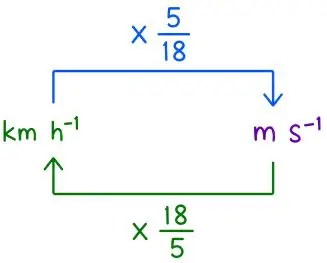
Relationship Between km h–1 and m s–1
1 km h–1 \(=\frac{5}{18}\) m s–1
Download ICSE Class 7 Physics Physical Quantities and Measurement Notes PDF
Students searching for ICSE Class 7 Physics Physical Quantities and Measurement Notes PDF Download can use these notes for free study support. Save the PDF and revise anytime on mobile or computer.
Why Download These Notes?
- Easy language for quick understanding
- Important definitions included
- Exam-oriented short notes
- Helpful diagrams and examples
- Perfect for last-minute revision
Conclusion
The chapter Physical Quantities and Measurement is an important topic in ICSE Class 7 Physics. Understanding measurements, SI units, and measuring instruments helps students build a strong base for higher classes.
By studying these notes regularly, students can improve their understanding and score better marks in examinations.
For more ICSE study materials, chapter notes, and PDF downloads, keep visiting your learning portal regularly.
ICSE Class 7 Physics Notes
| ☛ ICSE Class 7 Physics Chapter 1 – Physical Quantities and Measurement Notes |
| ☛ ICSE Class 7 Physics Chapter 2 – Motion Notes |
| ☛ ICSE Class 7 Physics Chapter 3 – Energy Notes |
| ☛ ICSE Class 7 Physics Chapter 4 – Light Energy Notes |
| ☛ ICSE Class 7 Physics Chapter 5 – Heat Notes |
| ☛ ICSE Class 7 Physics Chapter 6 – Sound Notes |
| ☛ ICSE Class 7 Physics Chapter 7 – Electricity and Magnetism Notes |
Official Website:
Students can visit the official CISCE website for more details and updates.